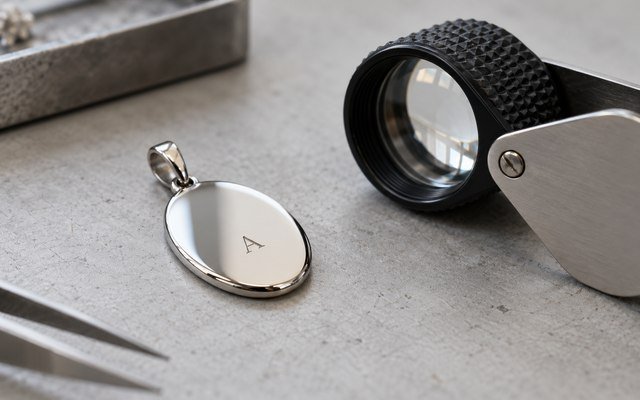
Evaluate small jewelry laser engraving on the finished surface at actual size, using agreed viewing conditions and exact approved text. Check readability, character separation, placement, edge clearance and finish interaction. A magnified artwork preview or a laser process name does not prove that a customer can read the final mark.
A logo can look sharp on a screen and become indistinct on a curved ring interior. The challenge is not only reducing the artwork. Buyers need to connect the design file, available marking area, process and finished-product reference.
Lock the message and marking area
Specify the exact letters, symbols and punctuation. Distinguish a decorative logo from a SKU, serial reference or other mark that must be transcribed reliably. Define the permitted marking area using the actual component geometry, including curvature, joints and nearby stones. Check that the artwork’s orientation matches the worn product.
Use the logo artwork handoff guide for file and placement control. Keep a real-size proof alongside the enlarged version. Do not invent a minimum readable font size without trial evidence; material, contrast, stroke design and viewing conditions all influence the outcome. Approve the text separately from the visual style so a beautiful mark does not conceal a spelling error.
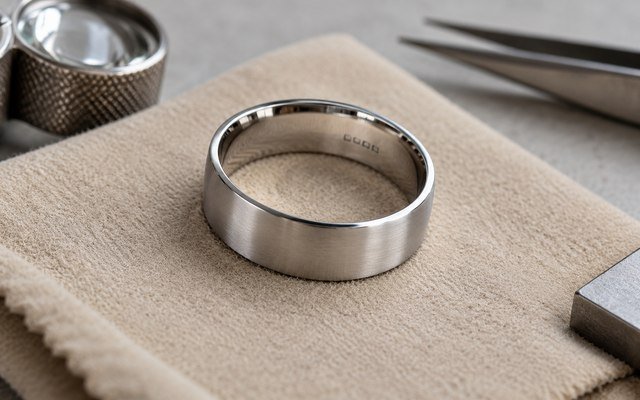
Identify which marking process is proposed
Laser marking describes more than one process. Ask whether the supplier proposes material-removing engraving, a surface color change or another suitable method. Confirm how the chosen process interacts with polishing and coating, and whether marking occurs before or after the final finish.
The TRUMPF laser marking methods distinguishes marking approaches. The TRUMPF laser engraving overview explains engraving as material removal. These descriptions help you ask precise questions; they do not guarantee a particular depth, contrast or corrosion performance on your jewelry. A change in process sequence may require a new sample even when the artwork is unchanged. Keep the approved process description connected to the actual finished reference.
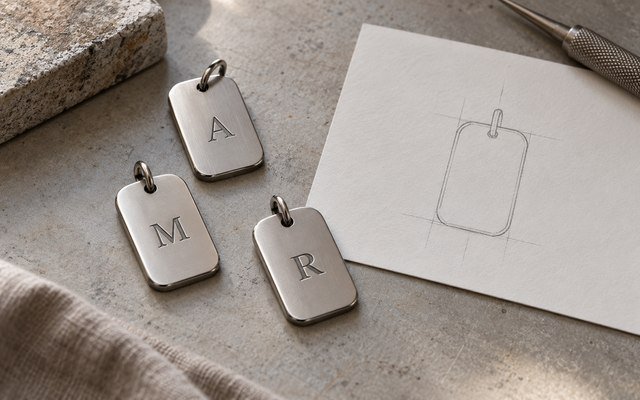
Check legibility under repeatable conditions
View the finished sample without relying only on a macro photograph. Agree lighting, angle, viewing distance and whether magnification forms part of the inspection. Ask a reviewer to read or transcribe functional text where appropriate. Inspect similar characters, narrow gaps and curved-surface distortion.
If dimensions or stroke spacing require measurement, the NPL callipers and micrometers guide provides measuring-practice context. Select a method suitable for the small feature instead of assuming ordinary calipers can resolve it. Record both readable appearance and any specified dimensional requirement. A mark can be dimensionally accurate but hard to read because reflections obscure it. Keep photographs as supporting evidence, not as the sole acceptance basis.
Control repeat orders and personalization files
Save the approved artwork version, placement reference, process sequence and finished sample. For variable text, use a controlled order file that preserves characters and associates each mark with its SKU. Establish who checks the proof and who releases production.
Use the personalization proof process when names or other customer text vary. A new surface finish, marking location or component curvature can change readability even with the same file. Review these changes before repeat production. Keep rejected versions clearly separated from the current artwork so the operator cannot select an obsolete logo by filename alone.
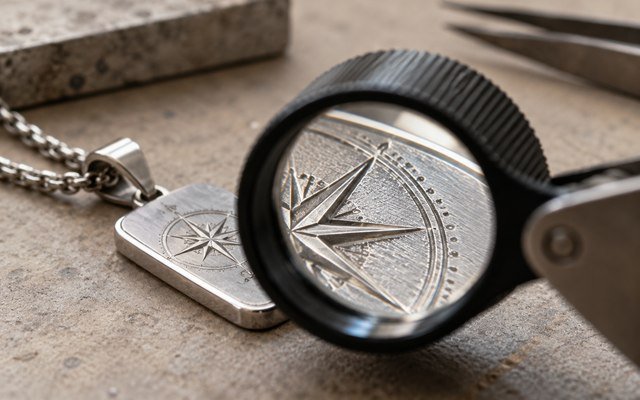
Buyer’s working record
Use these fields as a starting point and adapt the acceptance basis to the actual product. This is a proposed purchasing worksheet, not evidence of a completed Yleryler inspection.
| Field | Record | Decision purpose |
|---|---|---|
| Text | Exact characters and version | Verify spelling separately |
| Geometry | Area, curvature and clearance | Review the actual component |
| Process | Method and finish sequence | Approve a finished sample |
| Appearance | Viewing and transcription rule | Avoid screen-only approval |
Illustrative purchasing example
Hypothetical example: an inner-ring message is readable in an enlarged digital proof but two letters merge on the finished band. Review the actual-size layout and process sample. Reducing complexity or adjusting stroke spacing may be more useful than demanding an arbitrary increase in laser power.
Approval and follow-up workflow
Build an approval pack containing source artwork, actual-size proof, location image and finished-sample photographs. Record any product-specific readability criteria and the reviewer. If the mark is intended to support traceability, test the complete identification workflow as well as its appearance. A legible character sequence is only useful when it matches the correct product record.
Frequently asked questions
Is there one minimum font size for jewelry engraving?
No. Confirm readability on the actual material, geometry and finish using suitable samples.
Does deep engraving always read better?
No. Depth, stroke design, contrast and viewing conditions interact.
Should buyers approve artwork or the finished mark?
Both. Artwork approval establishes the message; the finished sample establishes the product-specific result.
Discuss your wholesale jewelry requirements
Planning a stainless steel jewelry order? Send Yleryler your drawings or SKU references, complete assembly details, intended quantities, finish, destination market and the requirements discussed above. Include the approved sample revision and any independent inspection or testing expectations so the project can be reviewed before a quotation is prepared. Contact Yleryler with your product brief.
Prepared by the Yleryler editorial team for B2B purchasing. Technical links checked on 13 October 2026. Linked sources support background concepts; the worksheets and hypothetical examples are proposed workflows. They do not certify a Yleryler product or replace product-specific assessment.