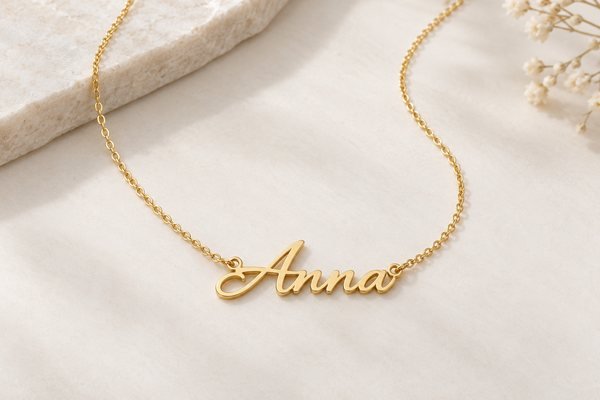
A personalized necklace can be made accurately from the wrong text. One missing accent, an unintended capital letter or an outdated proof can make the finished piece unusable for its intended recipient. For wholesale personalization, the order workflow deserves as much attention as the metal and finish.
Approve personalized name necklaces using an exact text record, supported character checks, a real-size layout proof and a version-linked production release. Keep the customer text, artwork and SKU connected. Never allow a verbal correction or message screenshot to become an untracked replacement for the approved file.
1. Capture the text exactly as supplied
Use a structured order sheet with one row per personalized unit or repeated text group. Record spelling, capitalization, spaces, punctuation and accents exactly. Keep the original customer input alongside any production-ready artwork so changes are visible.
Avoid retyping names across multiple systems where possible. If retyping is necessary, arrange an independent comparison before approval. A familiar-looking name can still be incorrect, and the production team should not silently normalize spelling or remove characters.
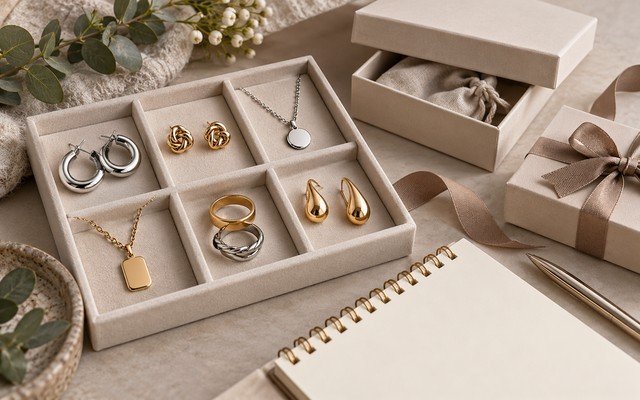
Browse our stainless steel necklace and pendant collection to discuss chain and pendant directions, then submit your exact name text and dimensioned proof. A catalogue pendant is not approval of a custom name-cutting layout.
Digital text can encode visually similar characters differently; see Unicode normalization FAQ for technical background. Preserve the customer’s exact input and approve the final visible artwork separately.
2. Check character support before pricing
Confirm whether the proposed font and manufacturing approach support every required character. Non-Latin text, connected scripts, accents and symbols may require additional artwork review. Ask for the actual outline rather than assuming a font preview will translate directly into a producible piece.
Identify delicate connections, enclosed areas and unsupported sections in the layout. The supplier should review whether the letter structure is suitable for the proposed construction. Resolve manufacturing changes with the buyer instead of simplifying characters without approval.
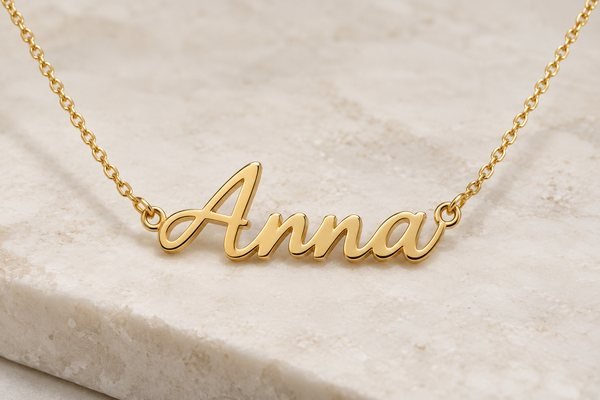
3. Approve a proof at the intended scale
Record overall width and height, letter thickness, connection points and chain attachment positions. A digital preview enlarged on a screen can hide how small a character or connection will be in the finished product.
Provide a dimensioned proof and, where practical, a print-at-size reference. Describe the dimensions separately from the image so printer scaling does not become the specification. Review whether longer names change the overall size, letter proportions or price.
4. Link each approval to one revision
Give every proof a revision identifier and mark its status: awaiting review, correction requested or approved for production. Record who approved it and when. A new customer correction should reopen the approval rather than travel as a separate informal note.
Separate text approval from physical product approval. A correct spelling proof does not confirm finish, chain length, edge treatment or assembly quality. For a new design approach, approve the relevant physical sample before releasing the personalized batch.
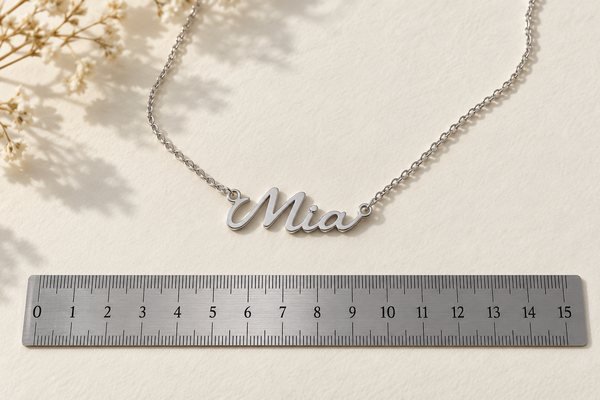
5. Confirm manufacturability and sample acceptance
For a custom name necklace manufacturer, proof approval should cover more than spelling. Ask the production team to identify narrow letter bridges, unsupported strokes, sharp internal corners and the position of each chain attachment. The minimum viable stroke or bridge width depends on the material thickness, cutting or forming method and the individual artwork; do not use one universal dimension for every name.
Before bulk production, compare the physical sample with the signed drawing: measure the pendant’s maximum width and height, inspect edges for burrs or uncomfortable corners, check symmetry and balance when suspended, and verify both jump-ring closures and the clasp. Specify chain length including or excluding any extension chain, and check the agreed metal finish under consistent lighting. For gold-tone PVD finishes, agree a physical color reference rather than approving color from a screen alone.
Set measurable tolerances case by case: list each nominal dimension, permitted variation, cosmetic acceptance rule and inspection method on the approved specification. Record any sample deviation and require buyer approval before revising the drawing.
6. Audit the batch before packing
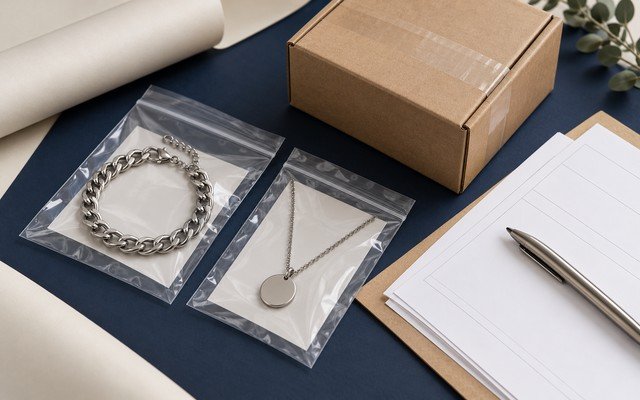
Use the template below to compare each finished piece with its own approved proof. Check text and layout before the item enters its labeled pouch. Keep pieces identifiable during sorting so correctly made products do not reach the wrong recipient.
For repeated names, state the quantity clearly. For unique names, verify the unit count and matching labels independently. Photograph representative approved layouts and any exceptions, then retain the final order record for customer service and future repeat requests.
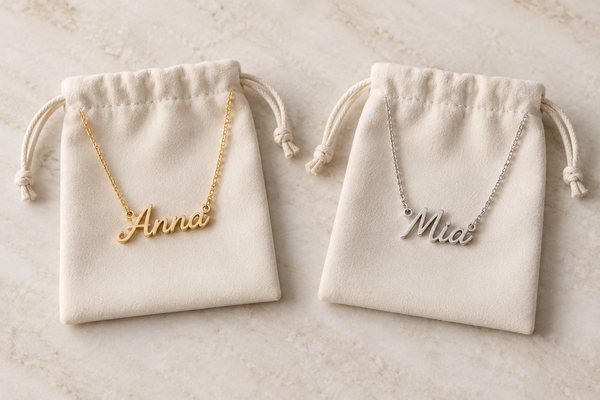
Copyable buyer review template
Copy these headings into your working spreadsheet. Add the product SKU, sample revision, date, reviewer, findings, responsible person and final decision. Example fields are planning aids; acceptance criteria must be agreed for your actual product.
| Order field | Entry required | Approval checkpoint |
|---|---|---|
| Text | Exact name, accents and case | Compare with original input |
| Layout | Font/outline and finished dimensions | Approve dimensioned proof |
| Revision | Proof ID, reviewer and date | Release one version only |
| Packing ID | Unit label and recipient/order reference | Match item to label |
Extended bulk-order proof and inspection fields
For bulk personalized necklaces, add the following columns to the worksheet above. Keep a separate row per unique name and variant, even if multiple units share the same text.
| Field | Record / decision |
|---|---|
| Order and identity | PO number, SKU, line number, exact text, character set, quantity and recipient / packing reference |
| Material and finish | Agreed stainless steel specification, finish and physical color reference, where applicable |
| Geometry | Approved artwork ID, pendant width / height, material thickness, connection and attachment locations, agreed tolerances |
| Necklace assembly | Chain style / length, extension length, clasp type and finish |
| Approval control | Proof revision, sample reference, approver, sign-off date and production-release status |
| Finished inspection | Inspected quantity, spelling match, dimensional check, edge / clasp condition, defect notes, rework or acceptance decision |
| Traceability | Batch or job ID, unit label, packaging check, inspection owner and record date |
Suggested release rule: never approve a name or design variant with an unresolved spelling, character, or artwork mismatch. Hold affected units separately until the buyer confirms a revised proof and disposition. Agree any sampling plan in advance; a random sample alone may not reliably catch errors when every necklace has unique text.
Practical example — hypothetical
A hypothetical buyer orders 60 personalized necklaces. One accented name is entered correctly but loses its accent when a font outline is prepared. The reviewer compares the proof with the original text and flags the change before production. A revised outline receives a new approval ID, and packing uses that same ID. The example demonstrates error prevention, not a documented Yleryler customer result.
How to document a real production example
For a buyer-approved, non-confidential case record, show the original text entry, redacted proof revision, marked correction, signed final artwork and matching labeled finished product. Include the inspection decision and the action taken. Publish customer names, order quantities or photographs only with permission. The hypothetical example above is not evidence of a completed Yleryler project.
Frequently asked questions
Who should approve the spelling on a name necklace?
The buyer should nominate an approval owner and, when applicable, obtain the end customer’s confirmation. The supplier should also compare production artwork with the approved text, but should not guess the intended spelling.
Can every name use the same necklace width?
Not automatically. Longer names and different character shapes can change proportions and manufacturability. Define whether overall width or letter height is controlled, then approve the resulting layout.
What happens if the customer changes a name after approval?
Pause the affected unit and issue a revised proof. Confirm whether production has started and assess timing or cost implications before accepting the change. Release only the newly approved revision.
Related buyer resources
custom jewelry artwork preparation · SKU labeling and packing lists · production timeline planning
Discuss your wholesale project with Yleryler
If you are comparing suppliers for bulk personalized necklaces or sourcing a custom name necklace manufacturer, request a proof workflow and sample review alongside the unit quotation. A dependable approval trail is especially important when a purchase order includes many unique names, sizes or delivery labels.
Send Yleryler your exact text list, preferred character style, target dimensions, chain length, finish, unit quantities and labeling requirements. Include your proof-approval deadline and delivery destination so we can assess the personalization workflow.
Request a Product-Specific Wholesale Quote
Images are AI-generated product concepts for educational illustration, not photographs of actual Yleryler stock, tooling or customer orders. Dimensions and product performance must be reviewed using the actual approved sample.