Plan a men's stainless steel jewelry collection around a defined customer, a small number of style roles and a manageable set of fit and finish options. The goal is a range that can be explained, sampled, purchased and replenished coherently. A larger catalog is not automatically a stronger opening order.
Start with the sales channel and the wearer. A gift-focused online brand, a streetwear store and a formal accessories retailer may need different proportions, presentation and purchase units. Treat these as merchandising choices to test, rather than assuming one universal men's jewelry trend applies to every buyer.
Give every style a clear role
Identify what each design contributes. A plain band can serve as an entry item, a chain as an everyday staple, a pendant as a recognizable motif and a bracelet as a complementary purchase. The roles can vary, but they should be explicit before samples are requested.
Build a simple range map showing category, visual weight, finish, intended price position and wearing context. This prevents several nearly identical designs from consuming the budget while an important category or fit requirement remains untested.
Shopify's assortment planning guidance provides useful background on breadth and depth. Apply those concepts to the actual business: breadth is how many different offers the customer sees, while depth concerns the stock commitment behind them. Neither measure alone establishes commercial success.
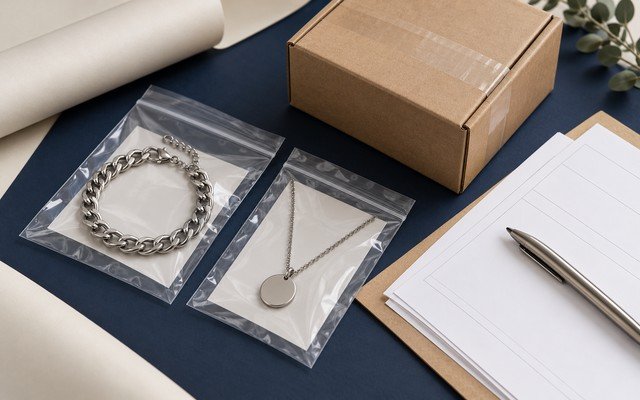
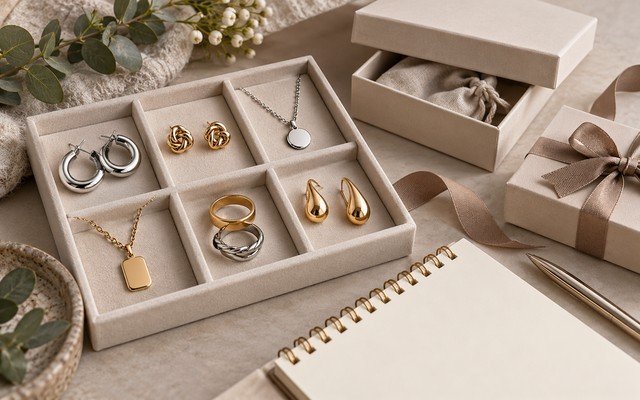
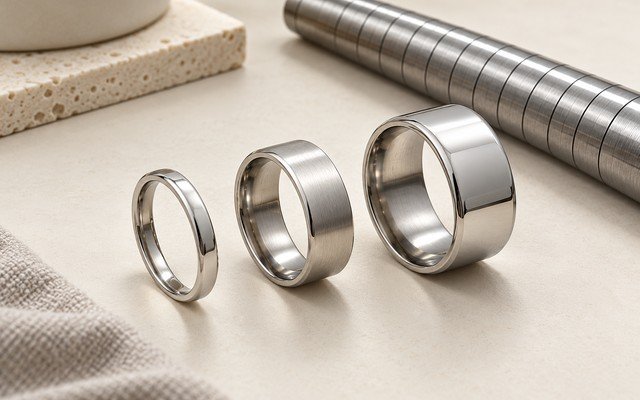
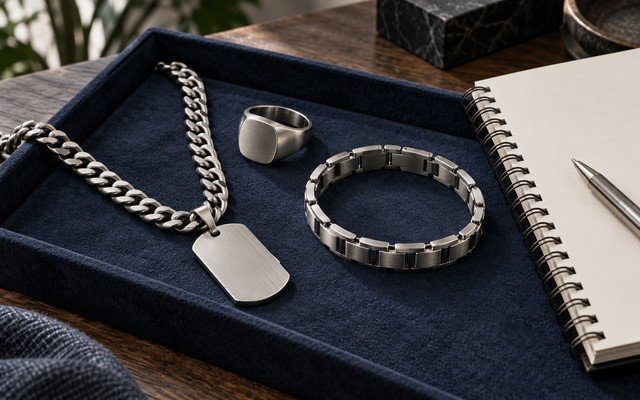
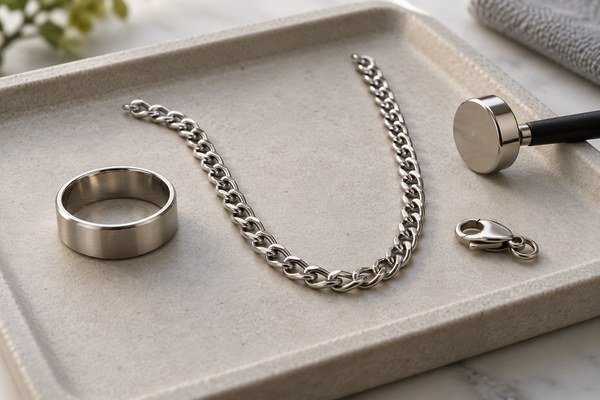
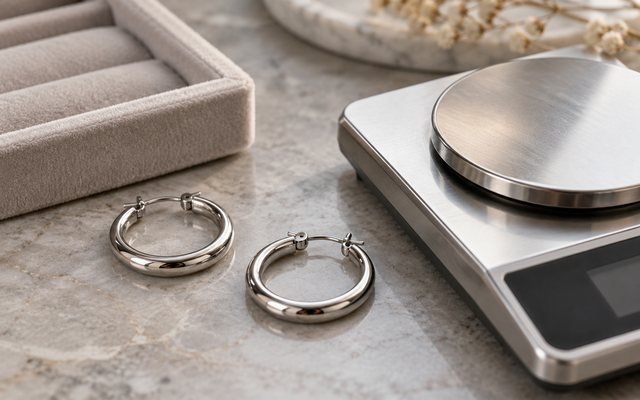
Images are editorial illustrations, including AI-generated concepts. They are not photographs of verified production, test results or approved customer samples.
Control the multiplication of variants
A collection can expand quickly when each design is offered in several colors, lengths and sizes. Calculate the number of purchasable variants before discussing an order total. The supplier's minimum may apply by style, finish, size or another production grouping.
As a hypothetical planning example, four ring designs with two finishes and five sizes create forty variants. That arithmetic says nothing about demand. It simply shows why a modest design count can still produce a complicated stock plan. Confirm how the proposed supplier groups these variants for quotation and production.
Avoid using a single generic quantity against the whole collection. Allocate quantities deliberately, show the assumptions behind the allocation and separate stocked options from made-to-order possibilities. This makes the first buying discussion much more useful.
Review proportions on actual wear references
Photographs alone can hide thickness, weight and the way a piece moves. Ask for the measurements relevant to each item: chain length and width, pendant dimensions, bracelet wearing length, ring width and internal profile. Record the reference used for any on-body image.
A substantial appearance does not have to mean uncontrolled weight. Compare the complete construction and wearing experience, including clasps, sharp transitions, underside surfaces and contact with clothing. A decorative detail that looks distinctive on a tray may catch on a sleeve or feel awkward when layered.
Use a representative sample review with people who resemble the intended customers and wearing situations. Record observations separately from broad conclusions. A few positive reactions can guide the next sample decision; they do not prove market-wide demand.
Decide how pieces relate to each other
A coordinated range benefits from deliberate choices about finish, motifs and proportions. Establish whether the chain and bracelet should match closely, whether the pendant uses the same visual language and whether mixed finishes are intentional. Keep the styling rationale separate from manufacturing tolerances.
Review the complete purchase presentation. A chain sold alone may need different packaging and photography from the same chain paired with a pendant. Confirm whether a set has its own stock identity or consists of individually managed items.
GS1's GTIN Management Standard is a useful reference when deciding trade-item identification for retail partners. An internal SKU and a GTIN serve different functions, so follow the customer's actual identification requirements rather than treating the terms as synonyms.
Build the opening order around learning and reordering
Define what the first order should teach you. Questions might concern preferred chain proportions, finish choice, ring fit or the value of a coordinated gift set. Keep enough consistency that the answers can be interpreted, rather than changing every design variable at once.
Track performance at variant level and distinguish low demand from periods when an item was unavailable. Shopify's inventory reporting documentation illustrates the importance of knowing what each inventory measure includes. The same discipline applies in a spreadsheet or another retail system.
Before approving production, record the reorder specification, packaging version and expected replenishment review point. A promising design becomes easier to scale when the business can identify exactly which version customers bought and which fit or finish generated avoidable returns.

Men’s jewelry opening-range planning matrix
| Range role | Representative direction | Buying control |
|---|---|---|
| Core everyday | Simple chain or ring | Fit, repeatable finish and replenishment |
| Statement | Chunkier bracelet or pendant | Weight, comfort and wear testing |
| Layering | Complementary lengths and profiles | Clasp compatibility and visual coordination |
| Trial style | Limited new silhouette | Explicit reorder decision and limited variants |
Illustrative buyer decision
Rather than buying equal quantities of ten untested bracelet variants, a new wholesale brand can select a smaller number of clear style roles, collect fit and sell-through feedback, and reorder only when evidence supports it. This is a planning scenario, not a sales forecast or a claim about Yleryler’s inventory.
FAQ
How many designs should a first men's collection contain?
There is no universal number. Choose a range that covers the intended style roles while fitting the sampling budget, variant count and supplier's actual order structure.
Should every design be offered in silver and gold tone?
Only when there is a clear merchandising reason and a workable buying plan. Adding finishes increases stock decisions, documentation and sample approval work even when the base shape stays the same.
Can a wholesale catalog identify the best sellers in our market?
It can help build a shortlist, but it cannot establish your customer demand. Use a controlled opening order, accurate product presentation and recorded sales and return observations to guide expansion.
Editorial review and buyer-use limitations
This article is published by Yleryler for wholesale stainless steel jewelry sourcing and OEM/ODM specification review. The practical examples are illustrative, not verified customer orders, product certificates or legal advice. Buyers should verify material, technical claims and market-specific requirements against their actual approved specifications and the authoritative sources linked below. No individual professional qualification or independent third-party review is claimed.
Sources and further reading
These references support the material, regulatory or buying principles discussed above. Product-specific purchasing recommendations are practical guidance; an industry reference does not certify a supplied item. Sources reviewed on October 22, 2026.
- Shopify: assortment planning concepts
- GS1 UK: product changes and GTIN identification
- Shopify Help: inventory reports and variant performance
Related buying guides and product options
For the next purchasing step, read Wholesale Jewelry Capsule Collection: A B2B Planning Guide and Low MOQ Jewelry Orders: Design a Pilot That Answers a Buying Question. Explore our stainless steel bracelet bangle collection and contact Yleryler for an OEM/ODM sourcing review. Include your product type or drawings, estimated quantity, stainless steel grade and finish, destination market, required evidence or testing, preferred delivery terms and target date. We can then clarify the quotation scope and product-specific approval criteria. Material grade, process, evidence, MOQ, pricing and delivery are confirmed for the actual quotation and approved specification.