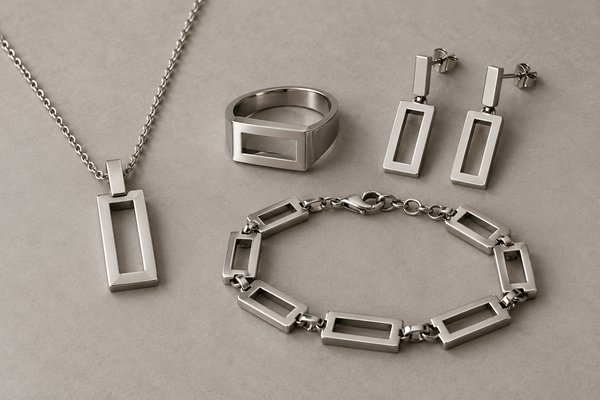
A coordinated jewelry capsule gives a retailer a clear story to present. That story does not require every piece to repeat the same motif at the same scale. A rectangular pendant can relate to a link bracelet through proportion, edge treatment or finish, while still serving a different wearing purpose. Start with the collection relationship, then decide which products deserve a place in the opening wholesale range.
A wholesale jewelry capsule collection is a focused range of necklaces, earrings, bracelets and rings linked by shared shapes, finishes or proportions. Build it around distinct product roles, then confirm the quantity, sample requirements, cost and reorder conditions for each SKU before committing to bulk production.
Choose the design language before selecting SKUs
Write down two or three rules that define the capsule. Examples include softened rectangular forms, consistent edge rounding and one restrained metal finish. Use those rules to evaluate candidates instead of selecting unrelated products because each looks appealing alone. A clear language makes later additions easier to assess.
Women’s Gold Stainless Steel Layered Necklace and Stainless Steel Stud Earrings can help you discuss necklace and earring roles within a capsule. Review their scale and approved finishes together before presenting them as a coordinated range.
For brand-identity background, see WIPO trademark guidance. Review your intended collection names and marks before finalizing branded cards or artwork.
Avoid copying one motif mechanically across every category. A shape that works as a pendant may be too heavy as an earring or awkward as a ring. Ask how the supplier would adapt the proportion and construction while keeping the collection relationship visible. Review the group together, then return to each item for its individual functional checks.
Give each product a commercial role
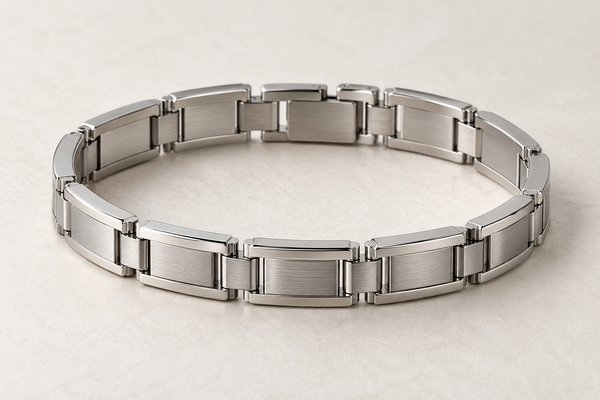
Separate the entry item, everyday core and visual statement within your proposed range. Those roles help you decide where detail and development effort matter most. A compact stud may introduce the collection, while a wider bracelet creates stronger visual identity. The roles are planning choices, not guarantees of sales.
Build a simple assortment sheet with category, role, finish, target quantity and expected selling channel. Keep quotation scenarios clearly labeled as scenarios until the order is agreed. If you do not yet know the demand, use a limited opening range and define what you want the first order to teach you. An oversized capsule can dilute attention and complicate replenishment.
Check coordination under real display conditions
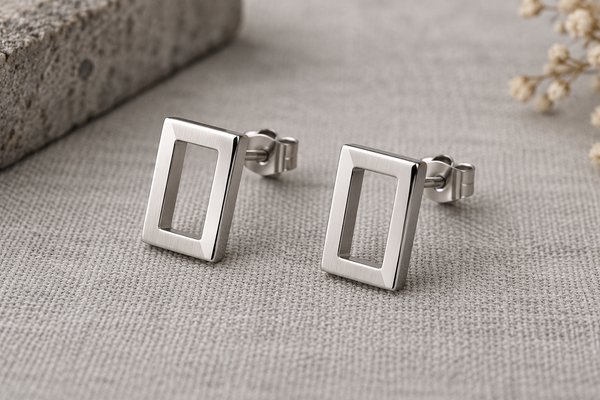
Place the samples on the actual cards, trays or website layouts you intend to use. A coordinated group should remain understandable when products are photographed separately. Compare metal shade and surface treatment under the same lighting. Components sourced through different production routes may need a more deliberate finish reference.
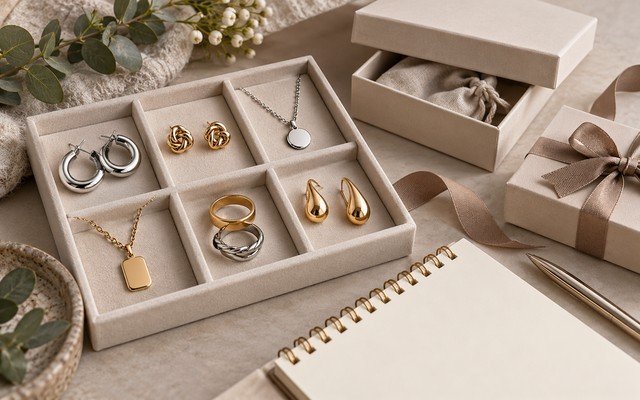
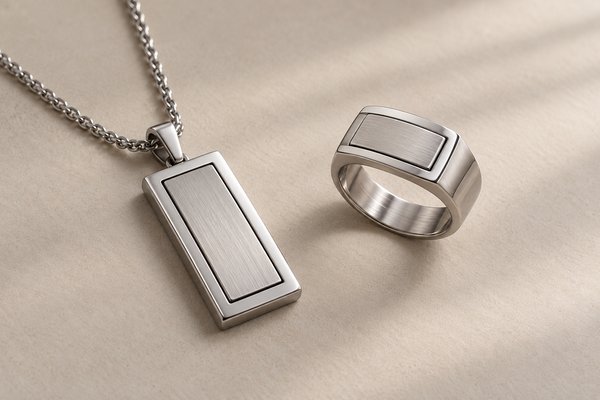
Look at scale relationships too. The pendant, earrings and bracelet need not be identical in size, but they should feel intentionally related. Take one group photograph and individual front and side images. Use them to spot a piece that looks disconnected. If it needs extra explanation to belong, decide whether to revise it or leave it for another collection.
Plan replenishment without forcing complete sets
A retailer may sell through the earrings faster than the ring. Agree whether products can be reordered individually and record any design or color minimums. Do not assume a capsule must always be purchased as a complete set. Flexible replenishment can be part of the brief, subject to the supplier's actual production conditions.
Keep shared references and individual SKU records together. If a finish or component changes, identify which products are affected. A collection-level record helps preserve the visual relationship, while item-level specifications control dimensions, closures and packaging. That combination is more useful than a mood board alone when the second order arrives months after launch.
A capsule planning sheet: a four-style example
For example, plan one pendant, one pair of studs, one bracelet and one ring in a single finish. That creates four styles; offering every style in two finishes creates eight style-color combinations before ring sizes are added. Quote each variant separately to see how color and size choices affect minimums, inventory and budget. This is an assortment example, not an available stock range or an order minimum.
| Product | Role to consider | Individual review |
|---|---|---|
| Rectangular studs | Entry item that introduces the design language | Post, backing, pair consistency |
| Rectangular pendant | Core focal piece for the collection | Bail fit and hanging position |
| Link bracelet | Stronger visual statement | Closure, movement and length |
| Geometric ring | Complementary category | Fit and contact edges |
These are planning roles, not sales forecasts. Remove a product if it adds complexity without strengthening the collection, and record individual replenishment requirements before the opening order.
Cost the capsule as individual sellable units
List quantity, development cost, packaging and reorder minimum for each product. A shared design language does not mean every SKU uses the same tooling or has the same minimum. Mark optional additions separately so they do not delay the core launch.
Use the quote comparison worksheet for opening and repeat-order costs. Connect the finished collection to the SKU and packing-list record so retailers can replenish individual pieces accurately.
Approve the samples together before authorizing the opening order. Keep a group finish reference plus an individual record of dimensions, weight, closures and packaging for each SKU. Record revisions and retain the approved sample for later comparison. Use our jewelry sample approval checklist to turn the collection idea into written acceptance criteria.
Wholesale jewelry capsule FAQ
How many products should a capsule include?
A four-style range covering earrings, a necklace, a bracelet and a ring is one starting example. Choose the final number from your budget, sales channel and SKU-level minimums. Count color and size variants separately when calculating the opening order.
Does every piece need the same finish?
No. A deliberate finish contrast can work, but document it so an intentional difference is not confused with inconsistent production.
Can different products share one MOQ?
Do not assume quantities can be pooled across the capsule. Ask for the minimum per design, color and size, and separate stock-item terms from custom development terms. Obtain written confirmation before allocating quantities.
Can a retailer reorder only the bestselling piece?
Ask whether individual SKUs can be replenished, what their repeat-order minimums are and which components remain available. Keep the approved finish reference and specifications with the order record.
Request a wholesale capsule review
Review our low MOQ jewelry pilot-order guide, then send Yleryler your capsule brief for a B2B review. Include:
- Reference images, product categories and shared design rules.
- Quantity per style, color and ring size; identify stock or custom requirements.
- Finish, logo and packaging requirements.
- Target market, budget and intended launch date.
Ask us to confirm feasibility, SKU-level MOQ, sample costs, development or tooling charges, and estimated lead times in the quotation before authorizing production.
Images in this article are illustrative product concepts; they are not photographs of an approved sample or inspection evidence.