Finding a jewelry manufacturer is not about collecting supplier lists; it is about proving whether a factory can meet your product, customization, quality, cost, and delivery targets. Many buyers rush to quote. Then they face hidden fees or delays. I will show you the screening steps I use daily as an OEM/ODM producer in stainless steel.
To find a jewelry manufacturer you can trust, choose a channel to discover candidates, then rigorously verify fit: materials, processes, MOQ, logo method, packaging, target market, samples-to-mass consistency, QC, lead time, and export support. Treat “best price” as total project risk, not just unit cost, before you commit to sampling or bulk production.
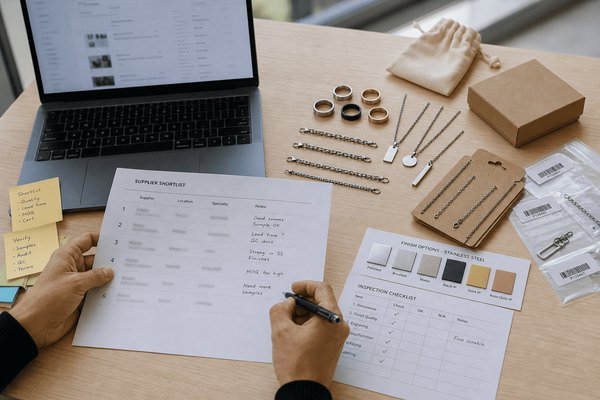
Most guides list directories and walk away. I will share what actually separates smooth projects from costly ones: how a professional factory thinks, what questions we ask before quoting, and how you can begin a structured supplier review.
Where should you actually look to find a jewelry manufacturer today?
You want quick options, but endless searching wastes time. The real bottleneck is evaluation. First, build a short list from obvious channels. Then switch 80% of your effort into verification. I have seen buyers spend weeks browsing, then rush screening and get burned on quality or delivery.
Use search engines, B2B marketplaces, trade shows, referrals, and social media to find a jewelry manufacturer, but treat them as discovery only. The win comes from disciplined screening: request the right data, test communication, verify process capability, and confirm samples-to-mass consistency before placing any order.
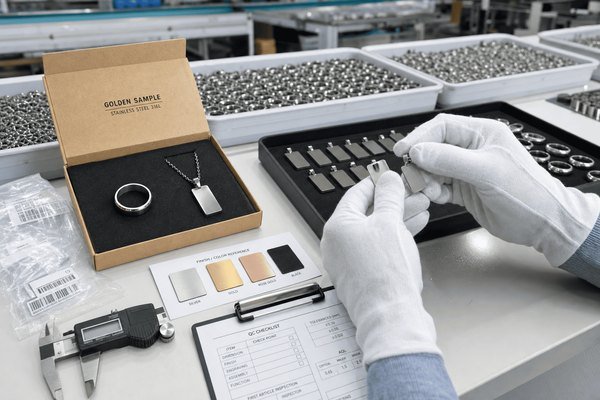
Discovery channels that work now
- Search engines: Combine “OEM/ODM,” material (e.g., 316L stainless steel), and process (e.g., PVD, casting).
- B2B platforms: Alibaba, Global Sources, Made-in-China, and for China domestic pricing research, 1688.
- Trade shows: Hong Kong Jewellery & Gem, Jewelry & Watch (HK), Canton Fair, Yiwu Fair.
- Referrals: Ask non-competing brands or packaging vendors who they trust.
- Social media: LinkedIn for factory managers; Instagram/TikTok for craft capability; Reddit/Facebook groups for candid reviews.
- Sourcing support: Agents or hybrid trading-factory partners can fit certain models.
Now stop scrolling. Take 5–10 candidates and start your fit tests. Any channel can produce a good or bad supplier. Your systematic evaluation turns chance into control.
Quick shortlist filter
- Match by material and process: Stainless steel vs brass vs silver. Casting vs CNC vs stamping. PVD vs electroplating.
- MOQ aligned with your stage: New brand? Look for flexible MOQ and phased deliveries.
- Communication speed and clarity: 24-hour response, structured answers, not copy-paste.
- Evidence: Photos, videos, certificates (e.g., material reports), and customer references when possible.
A practical sourcing approach is to compare suppliers using the same checklist, logo specification and agreed inspection plan. Discovery creates a shortlist; documented evaluation supports the final selection.
<p style="margin:0 0 20px;line-height:1.85;">When screening a supplier, a design such as <a href="https://yleryler.com/product/r006-gold-stainless-steel-blank-oval-signet-ring/">Gold Stainless Steel Blank Oval Signet Ring</a> can provide a concrete starting point for discussing the required dimensions, marking, sample scope and production record.</p>
How do you screen a jewelry manufacturer in the first 24 hours?
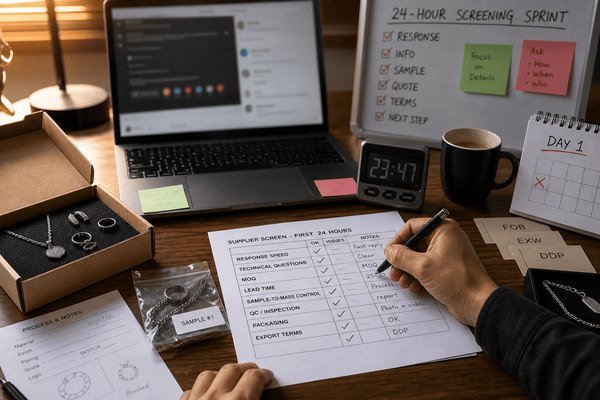
You may feel pressure to get a fast quote. Rushing creates holes. A structured 24-hour screen shows how a supplier thinks before money changes hands. I use a simple test: can both sides align on specs, risk, and timing in one day?
In the first 24 hours, test a jewelry manufacturer with a fit checklist: response speed, questions they ask, technical alignment, realistic MOQ/lead time, sample-to-mass control plan, and clarity on packaging and export terms. If they skip details, you risk cost overruns and delays later.
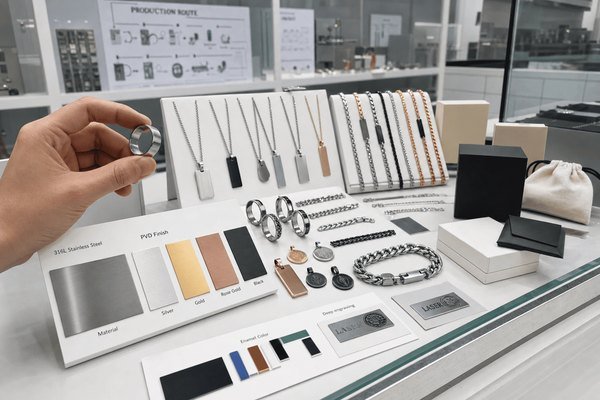
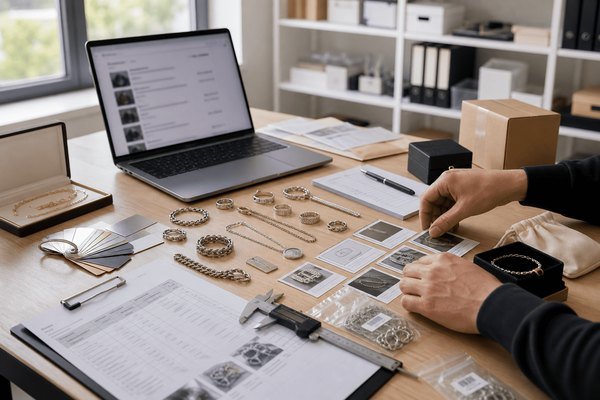
The 24-hour screening checklist
- Do they ask the right questions before quoting?
- Can they translate your references into process steps?
- Do they propose a sample-to-mass consistency plan?
- Are lead times realistic for your SKU count and finishing?
- Do they explain QC, AQL, and packaging clearly?
Green flags vs red flags
| Item | Green Flag | Red Flag |
|---|---|---|
| Response | Clear, numbered answers in <24h | Vague, slow, canned replies |
| Questions | Material, process, sizes, logo, packaging, delivery | “Send quantity, we quote now” |
| Lead time | Explains capacity, plating queues | “No problem” for every request |
| Samples vs mass | Golden sample + tolerances | “Mass same as sample, trust us” |
| QC | AQL levels, in-process checks | “QC good, don’t worry” |
| Incoterms | Transparent FOB/EXW/DDP options | No clarity on shipping |
Pro tip: Request a process map for the actual SKU, covering forming or machining, deburring, polishing, cleaning, the agreed coating process, logo marking, final inspection and packing. Confirm the operation sequence and coating specification for that design.
What should a jewelry manufacturer confirm before sending a quote?
A fast price without context is usually wrong. I never quote until I confirm variables that move cost, schedule, and risk. Serious buyers appreciate it. Casual buyers sometimes push for a number and regret it later.
Before quoting, a jewelry manufacturer should confirm material, process, sizes, tolerances, quantity, logo method, finishing, packaging, target market, compliance needs, and delivery expectations. Precise inputs create accurate pricing and protect your timeline, quality, and brand reputation.
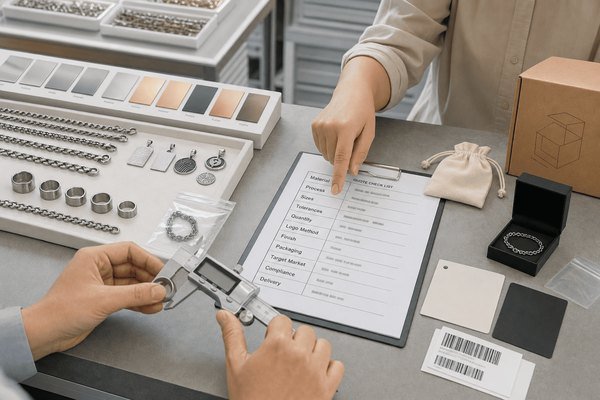
The must-ask questions
- Material: 316L stainless, 304, brass, or silver?
- Process: Casting, CNC, stamping, or combination?
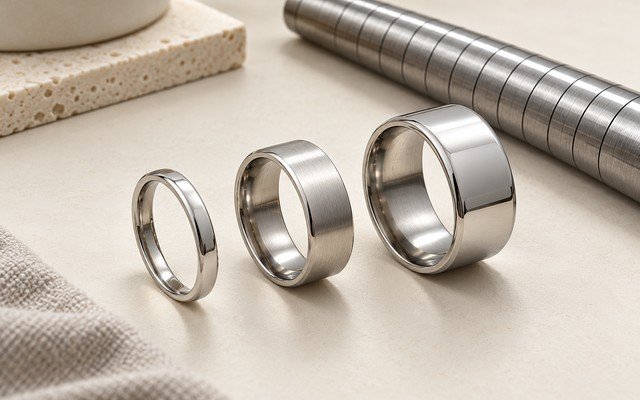
- Dimensions: Sizes, thickness, inner diameters; tolerances (e.g., ±0.2 mm).
- Finish: PVD color (yellow gold, rose, black), polish level, matte options.
- Logo: Laser mark, deep engraving, enamel infill, screen print.
- Quantity: MOQ per SKU, total assortment, phased deliveries.
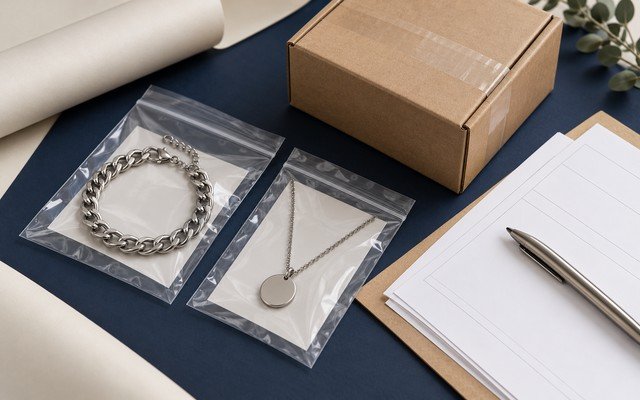
- Packaging: Polybag, velvet pouch, card, box, barcode, FNSKU, carton marks.
- Target market: Retail channel, Amazon FBA rules, climate conditions.
- Compliance: Any required tests (e.g., nickel release), country labeling; you must verify requirements.
- Delivery: Sample and mass lead times, shipping terms (EXW/FOB/DDP).
A simple inquiry template you can copy
- Reference images and drawings with dimensions.
- Material: 316L stainless steel.
- Sizes: Ring US 6–10; chain 18"/20"/22".
- Finish: PVD 18K gold, mirror polish.
- Logo: Laser on clasp, 5 mm wide.
- Quantity: 500 per SKU; 5 SKUs; phased 250/250.
- Packaging: Branded card, polybag, barcode, FNSKU label outside carton.
- Illustrative requested schedule: samples in 10 days and bulk production in 25–30 days after approval. These are buyer planning targets, not confirmed supplier lead times.
- Destination: Amazon FBA USA; request carton specs.
A complete brief supports a more accurate quotation. Confirm quotation validity, exclusions and any revision after sample development in writing. If data are vague, I will ask for clarification rather than guess. Guessing is expensive for everyone.
How do you keep samples and mass production consistent with your jewelry manufacturer?
Many buyers celebrate a beautiful sample, then get mass goods that look “almost” the same—different color tone, thinner plating, rougher polish. The solution is to control variables between sample and mass. This is where a professional factory earns its reputation.
Lock sample-to-mass consistency with a golden sample set, finish swatches, written tolerances, approved logo artwork, documented processes, AQL plans, and first-article inspection. Make suppliers show how they measure color, thickness, and size so mass cannot drift from the sample.
Build the control system
- Golden samples: Keep two sets—one for you, one sealed at factory.
- Tolerances: Document in mm and microns; do not rely on “same as sample.”
- Processes: Step-by-step SOP with checkpoints.
- QC: Incoming, in-process, final inspection; AQL levels defined.
- First-article: Approve the first mass piece before full run.
What to specify for stainless steel OEM/ODM
- Color: Agree an approved reference sample, lighting conditions and comparison method. If an instrumental color tolerance is required, document the method and agreed acceptance limit for the actual finish.
- Coating specification: Agree the coating system and any applicable thickness measurement, then verify the required appearance and performance on the actual product.
- Polish: Approve a physical finish reference and define how visible surfaces are inspected. Use a measured roughness requirement only where the design and measurement method justify it.
- Sizes: Identify critical dimensions, measurement points and design-specific tolerances in the approved drawing; distinguish nominal size from the acceptance range.
- Laser logo: Specify artwork dimensions, placement and the intended marking effect. If depth matters to the design, agree a measurable requirement and inspection method with the manufacturer.
- Enamel: Pantone code; test drop at sample stage; curing method documented.
- Packaging: Card thickness (e.g., 300 gsm), placement, barcode size, carton dimensions.
Create a one-page “spec card” per SKU. Include photos and numbers. Ask your factory to sign it with the golden sample. Then require:
- First-article inspection (FAI): Approve the first 5–10 pcs from the mass line.
- In-process checks: Every 200 pcs for color and dimension.
- Final inspection: AQL II, typically 0/2.5/4.0 for Critical/Major/Minor (adjust as needed).
Compliance note: For market-specific rules (e.g., EU REACH nickel-release requirements and, where applicable, U.S. lead limits for children's products), consult testing labs and your compliance team. A factory can share experience and SGS-style material reports, but you should validate requirements.
For an illustrative color specification, replace “gold color” with an approved reference sample and an agreed comparison method. Record the inspection conditions and acceptance criteria before production; this makes disagreements easier to resolve.
How do you compare total project cost and risk with a jewelry manufacturer?
Unit price looks attractive, but hidden costs explode later: extra packaging, relabeling, rework, or late deliveries that miss a launch. I always help buyers compare total project cost and risk, not just the per-piece number.
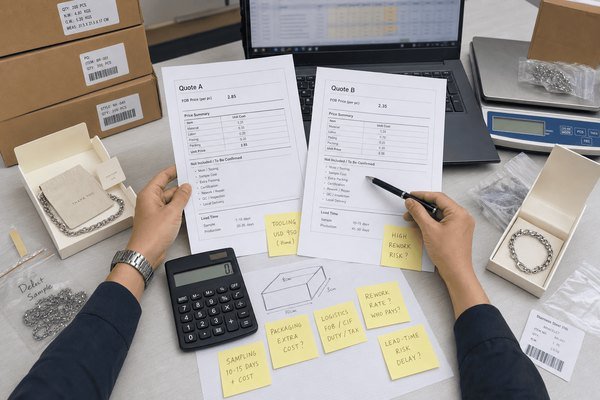
Compare total cost by including tooling, sampling, packaging, logistics, defect risk, rework, lead-time buffers, and communication overhead. A slightly higher unit price from a jewelry manufacturer can be cheaper overall if it reduces delays, scrap, and marketplace penalties.
Components of total cost of ownership (TCO)
- Unit price
- Tooling/setup: Molds, jigs, logo fixtures
- Sampling: Paid or refundable
- Packaging: Cards, pouches, boxes, barcodes, FBA labels
- Logistics: EXW vs FOB vs DDP; carton optimization; duties
- Quality risk: Expected defect rate; rework or returns cost
- Time risk: Late delivery penalties; lost sales window
- Communication: Time spent clarifying issues
Example comparison
Supplier A (low unit price):
- Unit price: $2.10
- Tooling: $0
- Packaging: $0.25 extra later (not disclosed)
- Defect rate: 5%
- Lead time overrun: +10 days
- Rework and relabel: $0.20
- Effective cost ≈ $2.10 + $0.25 + $0.10 + $0.20 = $2.65 (not counting missed launch)
Supplier B (higher unit price):
- Unit price: $2.35
- Tooling: $100 one-time (spread over 1,000 pcs = $0.10)
- Packaging: Included to spec
- Defect rate: 1.5%
- On-time delivery
- Effective cost ≈ $2.35 + $0.10 + $0.03 = $2.48
Supplier B looks “more expensive” at first glance, yet the project is safer and cheaper in reality. For Amazon sellers, add late shipment penalties, ranking hits, and customer reviews. Those are invisible on a quote sheet, but very real.
Tip: Request packed carton dimensions and weights before approving production. Compare freight quotations for the same destination, service and shipment scope; savings depend on the actual packaging and carrier terms.
When is a stainless steel jewelry manufacturer the right fit for your brand?
Not all categories need the same supplier. Stainless steel OEM/ODM shines when you want durability, allergy friendliness, and sharp customization with logos and color stability. It is not ideal for high-end precious metal positioning.
Choose a stainless steel jewelry manufacturer when the supplier can document the specified material, logo process, finish and production scope. Allergy-related and coating-performance claims require evidence for the actual product. For precious metal valuation or fine stone settings, consider a specialized silver or gold factory.
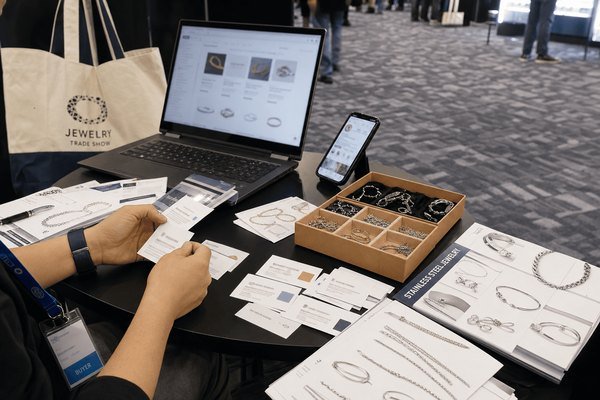
Strengths of stainless steel OEM/ODM
- Material: Record the specified stainless steel grade and request supporting material documentation. A grade name alone does not establish suitability for every wearer.
- Finishing: Compare the proposed coating system against the approved sample and agreed performance checks. Wear and color stability depend on preparation, coating configuration and use conditions.
- Logos: Laser, deep engraving, enamel infill are consistent.
- Processes: CNC, casting, stamping allow diverse shapes and weight control.
- Cost: Accessible price points for e-commerce and wholesale scaling.
Process and customization notes
- Material choice: 316L vs 304. 316L provides better corrosion resistance; most mid-tier brands choose 316L.
- PVD color control: Use color references and thickness targets; mirror polish before PVD gives the best shine.
- Logo methods:
- Laser marking: Fast, precise; best for clasp or inner band.
- Deep engraving: More durable; suits brand marks on rings/pendants.
- Enamel: Pantone-matched; make sure cure and adhesion are tested.
- Manufacturing routes:
- CNC: Sharp edges, precise sizes; ideal for rings and geometric pendants.
- Casting: Complex shapes and volume efficiency; control shrinkage in mold design.
- Stamping: Thin components like tags and simple pendants; cost-effective.
Private label packaging and export
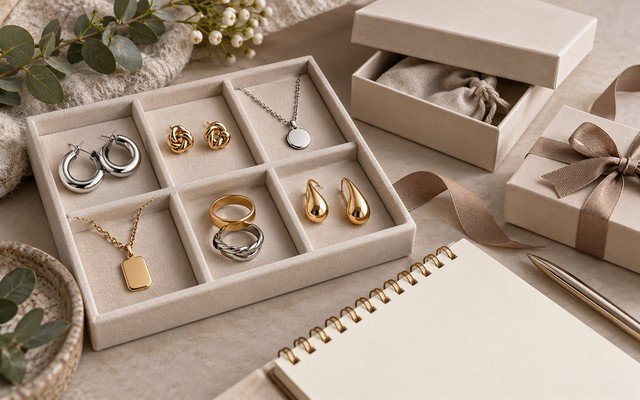
- Packaging: Brand cards with 300–350 gsm, velvet pouches, or boxes; anti-tarnish not needed for steel but presentation matters.
- Amazon FBA: FNSKU placement, suffocation warnings where required, carton labeling to spec.
- Export: Clarify Incoterms (FOB Ningbo/Shanghai or DDP to your warehouse), HS codes, and duty estimates. Verify local regulations independently.
Stainless steel can suit unisex collections when the design, material and finish meet the brand’s requirements. Evaluate skin-contact claims and reorder color consistency using product-specific evidence. For fine jewelry or complex stone setting, assess specialist silver or gold factories.
Turn your shortlist into a documented buying decision
Use the quote comparison worksheet to align specification and included costs. Record accepted dimensions, finish and function using the sample approval checklist, then plan the production milestones before committing to a launch date. Early communication is a screening signal, not proof of manufacturing quality.
Frequently Asked Questions
What is a reasonable MOQ for a jewelry manufacturer?
MOQs vary by process and packaging. For stainless steel, I often see 100–300 pcs per SKU for basic items, and 300–500 for multi-step finishing or complex colors. Factories may accept mixed sizes within one SKU. Ask about phased deliveries if you launch multiple SKUs.
How long do sampling and production usually take?
For stainless steel, sampling often takes 7–15 days depending on complexity and tooling. Mass production typically takes 20–35 days after sample approval. If you have multiple SKUs, add time for plating queues and packaging procurement. Confirm buffers around holidays or peak seasons.
Should I choose a trading company or a factory?
Both can work. A trading company may coordinate across multiple factories for mixed materials or complex sets. A direct factory offers process control and technical depth in its specialization. Pick the partner that best matches your category, communication style, and project risk profile.
What files do I need for a custom logo?
Send vector files (AI, EPS, SVG, or high-resolution PDF), plus a JPG/PNG for preview. Specify logo size, position, and method (laser, deep engraving, enamel). Add a tolerance for placement and depth. If using enamel, include Pantone codes and finish level (matte or gloss).
How can I protect my design with a jewelry manufacturer?
Use NDAs, watermark non-essential visuals before selection, and share full drawings only with shortlisted partners. Place clear ownership terms in the PO. Consider unique marks or serials. For critical IP, consult legal counsel in your jurisdiction; factories can support, but cannot guarantee legal protection.
<section data-yleryler-review="2026-10-buyer-spec"><h2 style="margin:38px 0 16px;line-height:1.35;">Supplier shortlist verification worksheet</h2><p style="margin:0 0 20px;line-height:1.85;">Use these fields in your purchase order or sample review. Numerical values and IDs below are illustrative, not live product specifications, test results or confirmed commercial terms. Agree measurement methods, tolerances and acceptance criteria for your actual design.</p><div style="overflow-x:auto;margin:26px 0;"><table style="width:100%;min-width:540px;border-collapse:collapse;font-size:15px;line-height:1.65;"><thead><tr><th style="padding:12px;text-align:left;vertical-align:top;border:1px solid #ddd;background:#f2f5f5;" scope="col">Field</th><th style="padding:12px;text-align:left;vertical-align:top;border:1px solid #ddd;background:#f2f5f5;" scope="col">Record or illustrative example</th><th style="padding:12px;text-align:left;vertical-align:top;border:1px solid #ddd;background:#f2f5f5;" scope="col">Verification before release</th></tr></thead><tbody><tr><td style="padding:12px;text-align:left;vertical-align:top;border:1px solid #ddd;">Process fit</td><td style="padding:12px;text-align:left;vertical-align:top;border:1px solid #ddd;">Named product, material and required operation</td><td style="padding:12px;text-align:left;vertical-align:top;border:1px solid #ddd;">Ask which operations are in-house and which use partners; retain the response</td></tr><tr><td style="padding:12px;text-align:left;vertical-align:top;border:1px solid #ddd;">Sample evidence</td><td style="padding:12px;text-align:left;vertical-align:top;border:1px solid #ddd;">Finished SKU and approved specification</td><td style="padding:12px;text-align:left;vertical-align:top;border:1px solid #ddd;">Review dimensions, function, finish and packing with documented findings</td></tr><tr><td style="padding:12px;text-align:left;vertical-align:top;border:1px solid #ddd;">Commercial fit</td><td style="padding:12px;text-align:left;vertical-align:top;border:1px solid #ddd;">Variant minimums, itemized costs and milestones</td><td style="padding:12px;text-align:left;vertical-align:top;border:1px solid #ddd;">Compare like-for-like quotations before authorizing paid development</td></tr></tbody></table></div></section>
Conclusion
Finding a jewelry manufacturer is a verification exercise, not a directory hunt. Match material and process, review communication against an agreed response schedule, lock specs for samples-to-mass consistency, and compare total cost and risk—not just unit price. If you want an experienced stainless steel OEM/ODM partner to review your brief, send an RFQ through the Yleryler contact form or email billh@yleryler.com. Let’s build smart, reliable product lines together.
<p style="margin:0 0 20px;line-height:1.85;"><small>Images are educational concepts, not evidence of actual factory operations, stock or inspected customer orders. Confirm specifications and performance using identified finished samples and applicable documents.</small></p>