A low unit price can become an expensive purchase when two suppliers are quoting different products. Stainless steel jewelry quotes often hide those differences in short phrases such as “standard packing” or “gold finish.” For a wholesale buyer, the useful comparison is the cost of receiving the agreed, saleable product.
Compare quotations against one written specification, separate one-time charges from recurring costs, and ask each supplier to identify exclusions. Do not rank prices until material, dimensions, finish, quantity mix, packaging and delivery responsibilities are aligned.
This worksheet approach is useful for buyers who already have a shortlist. If you are still assessing suppliers, start with our guide to finding a jewelry manufacturer.
First, define what one unit includes
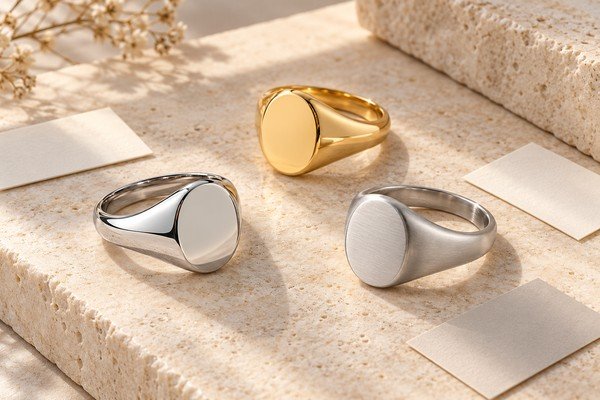
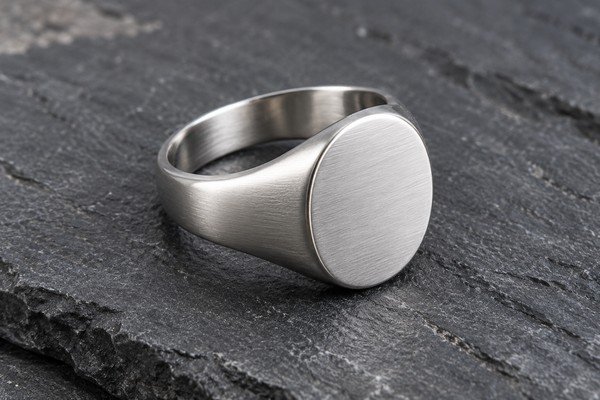
Take a signet ring as an example. A photograph does not establish its weight, wall thickness, inner profile or finishing standard. Two similar rings may require different amounts of material and polishing. Send a drawing or approved sample reference and ask the supplier to quote the same version.
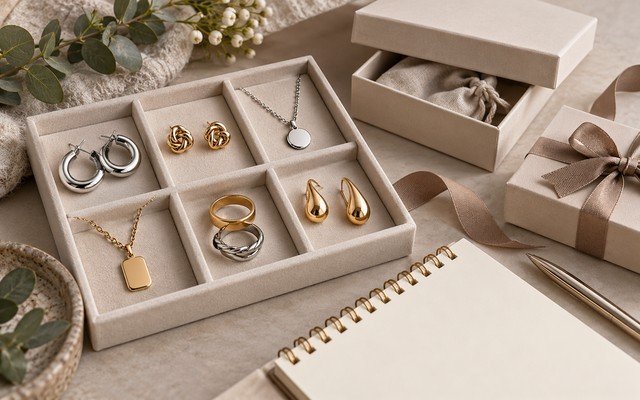
Use a design such as Gold Stainless Steel Blank Oval Signet Ring or Stainless Steel Stud Earrings as the starting reference for comparable quotes, then specify the same quantities, finish, branding and packaging for each supplier.
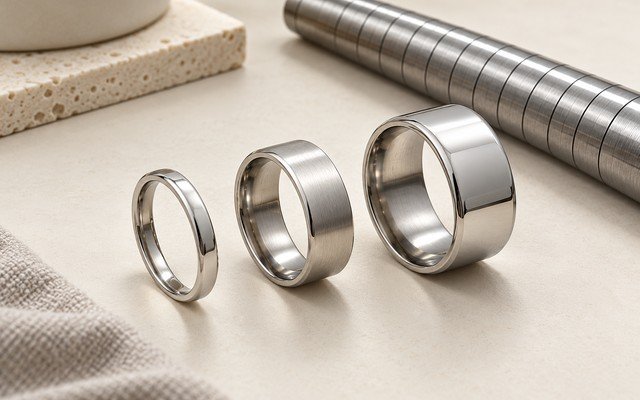
Identify the stainless steel grade in the written specification, even when your customer-facing description simply says stainless steel. Record the dimensions, size range, surface treatment and any stones or inserts. A substituted component should be listed as an alternative, with its price shown separately.
Put every quotation into the same cost table
Use the following rows in your comparison sheet. Request written answers for blank cells; a blank is not a zero.
| Cost line | What to confirm |
|---|---|
| Finished jewelry | Quantity per design, size and finish |
| Development | Drawing, tooling and sample charges separately |
| Branding | Logo position, method and setup cost |
| Packaging | Exact card, pouch, box and label specification |
| Quality work | Inspection scope and any requested laboratory work |
| Delivery | Named destination and included transport services |
Ask whether tooling belongs to the buyer, whether it can be reused, and what maintenance or modification costs may arise. Do not assume a sample charge will be refunded. If a credit is offered, record the qualifying order quantity and the way it will appear on the invoice.
Compare first-order costs and reorder economics
Imagine an illustrative order of 500 rings quoted at $2.40 each, plus $100 development and $0.30 packaging per piece. Before transport and other agreed charges, that order totals $1,450, equivalent to $2.90 per piece. These figures demonstrate the calculation; they are not a Yleryler price offer.
Supplier A vs Supplier B: an apples-to-apples example
A cheaper factory-gate unit price is not necessarily the cheaper first order. The example below assumes both suppliers quote the same approved ring specification, finish, quantity and packaging standard. The figures are illustrative, not live Yleryler prices.
| Cost item | Supplier A | Supplier B |
|---|---|---|
| Order quantity | 500 pcs | 500 pcs |
| Finished jewelry / piece | $2.40 | $2.55 |
| Finished jewelry subtotal | $1,200 | $1,275 |
| One-time development | $100 | $0 (included) |
| Packaging / piece | $0.30 | $0.20 |
| Packaging subtotal | $150 | $100 |
| First-order total* | $1,450 | $1,375 |
| Effective first-order cost / piece* | $2.90 | $2.75 |
*Excludes freight, import charges, taxes and any testing not specified in either quote. Supplier B is $75 less on the first order under these assumptions. If Supplier A’s $100 development charge does not recur, its identical 500-piece reorder would be $1,350 ($2.70 per piece), versus $1,375 ($2.75 per piece) for Supplier B, assuming all other prices remain unchanged.
A repeat order might omit the development charge, but only if the specification and tooling remain usable. Compare both the first-order and repeat-order totals. This helps explain why the lowest opening quote may not produce the best replenishment economics.
Also check whether the quoted volume means 500 pieces overall or 500 pieces per size and color. Five sizes and two finishes can turn a seemingly modest minimum into a very different commitment.
How do EXW, FOB and DDP change a jewelry quotation?
For the official definitions and allocation of delivery responsibilities, consult the International Chamber of Commerce Incoterms® rules. The named place and chosen rule should be recorded on every comparable quotation.
A supplier’s price is only comparable when the Incoterm, named place and included services are clear. An EXW price and a DDP price cannot be ranked by their headline amounts: they allocate freight, customs responsibilities and costs differently.
| Term | Typical supplier scope | Buyer must check |
|---|---|---|
| EXW (named place) | Makes the goods available at the agreed premises | Collection, loading arrangements, export formalities, freight, import clearance, duties and taxes |
| FOB (named loading port; sea/inland waterway) | Export-cleared goods delivered on board the vessel at the named port | Ocean freight, insurance where required, destination charges, import clearance and duties/taxes |
| DDP (named destination) | Delivery to the named place with import clearance and applicable duties handled by the seller under the term | Whether the seller can legally arrange import clearance, how import VAT is treated and any explicitly excluded charges |
Ask all shortlisted suppliers for a total on the same delivery basis. For a landed-cost comparison, add product, development, packing, origin handling, freight, insurance, destination handling, import duty and unrecoverable taxes where applicable. State the destination country, postal code and chosen transport mode. A DDP offer requires special care if local importer-of-record or tax rules prevent the seller from performing its obligations.
Review packaging as part of the product
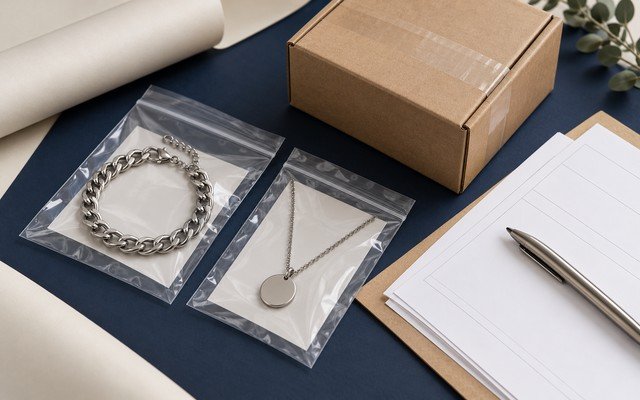
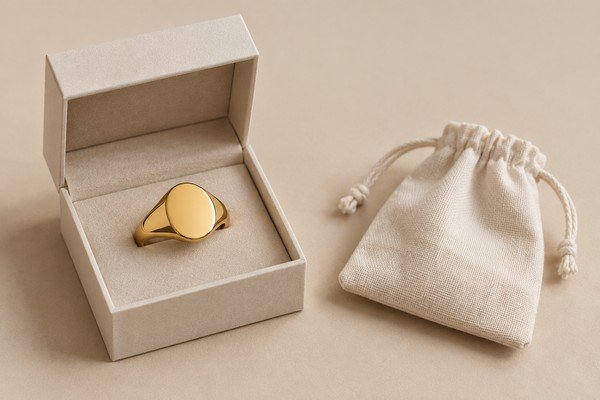
“Gift box included” is not a complete specification. Confirm dimensions, insert material, printing, individual protection and master-carton arrangement. Request a photograph of the packed sample and a description of what is included in the price.
A smaller package may improve handling, while a poorly fitted insert can allow metal surfaces to rub. Compare protection and presentation together. Ask for estimated packed weight and carton dimensions before comparing freight offers.
For projects involving cards, logos and presentation, our private label jewelry guide explains the broader development scope.
Ask the questions that reveal commercial gaps
Which payment event starts production? What information must be approved first? Is the lead time measured from payment, sample approval or receipt of final artwork? Ask suppliers to distinguish production completion from dispatch and arrival.
Confirm the quotation currency, validity period and treatment of changes. A price issued for a silver-tone ring should not silently carry over to a different finish or heavier design. Keep revised quotations numbered so purchasing and production use the same document.
What evidence should jewelry buyers review before placing an order?
An itemized price only helps when the delivered product can be checked against a written acceptance standard. For a custom stainless steel jewelry RFQ, ask for the following evidence alongside the final quotation:
- Material and finish: agreed stainless steel specification, approved surface finish, color reference and PVD or other coating scope where applicable.
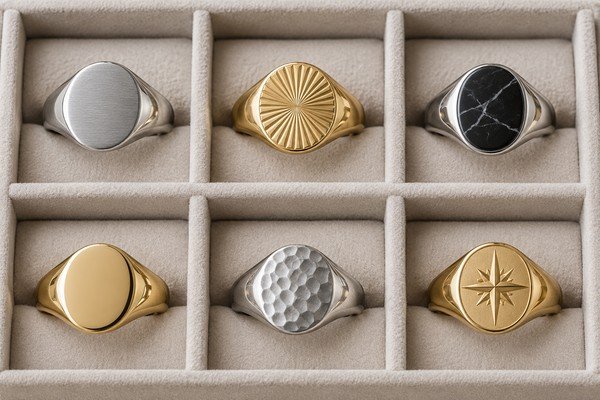
- Dimensions and appearance: approved sample or drawing, size breakdown, tolerances, stone setting or clasp requirements, and acceptable visible defects.
- Quality checkpoints: sample sign-off, in-process checks, final inspection criteria, packing review, and the party responsible for corrective action.
- Market-specific documents: where applicable, material or third-party test reports relevant to nickel release, lead, cadmium and other legal requirements in the destination market. Confirm the report identifies the tested item and the correct test scope; one report does not automatically cover an entire collection.
Yleryler OEM/ODM quotation guidance: Keep the approved sample, drawing revision, finish reference, logo artwork, packaging requirements and written quotation together. If the design, components or finish change, request an updated price and review whether the change affects testing or quality acceptance.
Make the award decision on evidence
Review the sample, the written specification and the quotation together. List unresolved items before issuing the purchase order. Agree how discrepancies will be investigated, what evidence is needed and who decides on rework or replacement.
Manufacturer’s perspective: a clear exclusion is easier to manage than an attractive promise with no defined scope. Choose the supplier whose commitments can be checked, then keep the approved documents with the order.
Make quote revisions comparable
Record quotation date, currency, validity, quantity per variant and named delivery scope beside the total. Separate optional tests and custom packing from the base product. Where a development charge is credited, show the qualifying quantity and credit on the order calculation. An empty cost cell means unresolved, not included at no charge.
Connect technical acceptance to the sample checklist and compare the readiness dates using the production timeline guide.
Request an itemized stainless steel jewelry quotation
To receive quotations that can be compared line by line, send suppliers the same concise RFQ: product reference image or drawing, dimensions and size mix, desired finish, order quantity by design and color, logo method, packaging, target market, destination and required delivery date. Ask for separate line items for sampling, tooling, finished products, special packaging, testing and freight.
Copy-ready RFQ structure: Product/style: ____ | Quantity per variant: ____ | Dimensions: ____ | Finish: ____ | Logo/artwork: ____ | Packaging: ____ | Destination and Incoterm: ____ | Target delivery date: ____ | Required tests/documentation: ____.
If you require custom branding, review our jewelry logo artwork guide before sending files. Request a detailed quotation from Yleryler with your reference images and order specifications.
FAQs: stainless steel jewelry quotation comparison
What information is needed for an accurate jewelry quotation?
Provide the design reference, dimensions, order quantity per variant, finish, branding, packaging, delivery destination and any required testing. An image alone may support a budget estimate, not necessarily a production-ready quotation.
Does MOQ mean per style, size or color?
It depends on the manufacturing process and supplier. Ask whether the minimum applies to the entire order, each design, each finish or each size, and obtain a written quantity breakdown.
Are sample or tooling fees refundable?
Not automatically. Ask whether credits are available, the qualifying bulk-order quantity and deadline, who retains tooling, and how credits will be shown on the invoice.
Can I compare an EXW price directly with a DDP price?
No. First normalize the quotations to the same Incoterm and named place, then account for freight, insurance, clearance, destination charges, duties and applicable taxes. Check importer-of-record feasibility before treating a DDP offer as fully executable.
Should I always choose the cheapest quote?
No. Compare the same specification and included services first. Then weigh sample results, communication, delivery feasibility and repeat-order support against the cost.
Can a supplier quote from a photo alone?
A preliminary estimate may be possible, but an order-ready quotation needs confirmed dimensions, construction and finish details.
What should I send Yleryler?
Send your sourcing brief with reference images, quantities by variant, required finish, packaging and delivery destination. Ask for development, product and packing costs as separate lines.
Images are AI-generated design illustrations. Confirm actual products and specifications against approved samples.