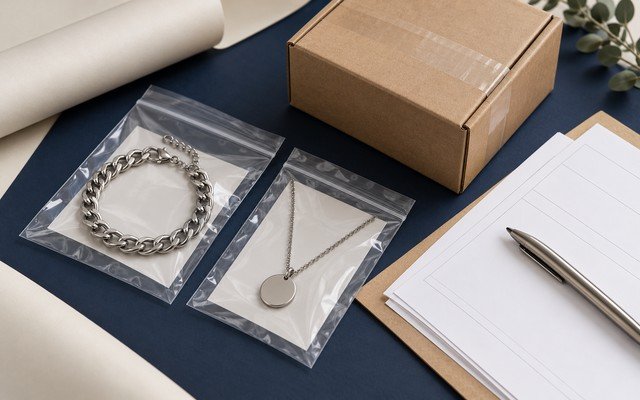
A carton contains the correct total quantity, but the warehouse cannot tell which gold-tone stud belongs to which stock code. Receiving slows down, products are relabeled by guesswork, and later sales data becomes unreliable. Jewelry SKU management begins before the packing list is printed.
Give each sellable variant a clear identifier, link it to a reference image and specification, and carry that identity through the unit label, carton contents and receiving record. Define whether quantities mean pieces, pairs or sets.
This operational guide uses stainless steel stud earrings because a small difference in shape, finish or backing can create a different retail variant.
Start with the sellable unit
Decide what the customer purchases: one earring, one pair, or a coordinated set. Use that unit consistently in quotations, purchase orders, packing lists and warehouse systems.
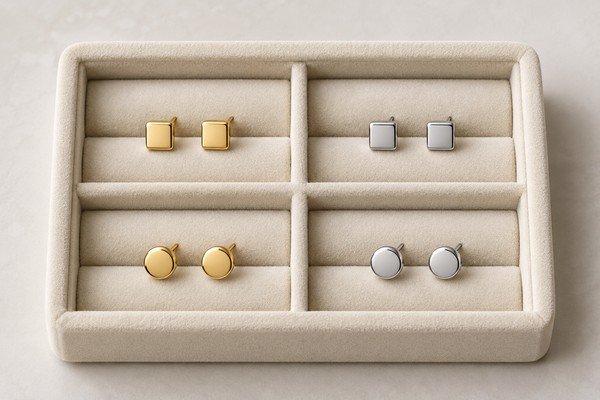
Keep Stainless Steel Stud Earrings and Gold Stainless Steel Stud Earrings distinguishable in the SKU matrix. Confirm each selected variant’s product reference, finish, sales unit and matching label before packing.
For an illustrative order of 200 pairs, the jewelry count is 400 individual earrings, before considering spare backs. A document that lists only “400 pieces” can be misunderstood by a team expecting 400 sellable pairs.
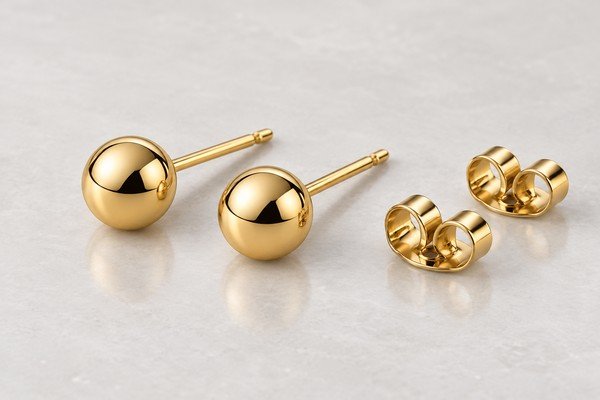
Record the backing configuration and included accessories. If one variant includes an additional pair of backs, its packing instruction should state that clearly rather than leaving staff to infer it from a photograph.
Build a variant matrix that people can read
Create one row for every sellable combination. Include the buyer SKU, supplier reference, design, finish, dimensions, sales unit and an unambiguous image.
Keep the identifier stable while the variant remains the same. Avoid changing codes simply because a spreadsheet is reorganized. Conversely, do not reuse one code for materially different products without a deliberate system decision.
| Matrix field | Purpose |
|---|---|
| Buyer SKU | Connects the item to the buyer’s stock record |
| Supplier reference | Connects it to the production or stock source |
| Finish and size | Separates visually similar variants |
| Unit | Distinguishes pieces, pairs and sets |
| Reference image | Supports visual receiving checks |
An internal SKU and a retail barcode are not automatically the same thing. If the channel requires a specific barcode system, confirm those requirements with the channel and relevant standards provider. See the official GS1 Global Trade Item Number (GTIN) guidance when deciding how retail product identifiers should map to your internal SKU records.
Keep product codes separate from lot records
A product identifier describes what the item is. A production or shipment lot helps identify where a particular supply came from. Both can be useful, but they answer different questions.
Two deliveries of the same stud earring may share a SKU while carrying different lot references. Keep that distinction so a quality concern can be investigated without losing the product’s sales history.
For changes to the actual specification, decide how the buyer’s system handles new versions. The supplier should not invent a coding policy on the buyer’s behalf.

Approve the label in the real packing position
Review text, finish name, quantity unit and any barcode at the actual printed size. Place the label on the intended bag, card or box and check whether it remains readable.
A label that looks clear on a screen may be covered when the pouch is folded or the box is stacked. Ask receiving staff to try the proposed arrangement before approving thousands of labels.
Keep the jewelry paired correctly. If the design has a left and right orientation, the packing instruction should show the required pair rather than merely state “two pieces.”
Make the packing list describe the cartons
Assign carton references and list the actual quantities by SKU inside each carton. For mixed cartons, show the mix. The warehouse should not have to open every package simply to understand the document.
Reconcile the packing list with the final packed quantities, especially after rework or a partial shipment. A list prepared before inspection may no longer match what was dispatched.
Our private label jewelry manufacturing guide explains how labeling fits into a broader branded-order brief.
Test the receiving workflow
Give a colleague an example carton, the packing list and the variant matrix. Ask them to identify, count and record the contents without verbal help. Note where they hesitate or make assumptions.
If scanning is involved, test with the intended device and system. A visual check of printed bars does not establish that data will populate the correct stock record.
Keep exceptions visible. Unlabeled, mixed or disputed units should be held for clarification, not quietly assigned to the closest-looking SKU.
Make corrections traceable
When a code or label is wrong, record the correction and affected stock. Update the supplier’s packing instruction and the buyer’s receiving reference together.
Preserve the original relationship where necessary to interpret earlier shipments. A clean current spreadsheet is useful, but it should not erase the information required to understand past deliveries.
My warehouse view: good identification reduces dependence on memory. The right person should be able to receive the order using the documents, even if they did not attend the development meetings.
Reconcile quantities before dispatch
Total the units by SKU from the carton rows and compare them with the purchase order. Count pairs, pieces and sets consistently. For illustration, six cartons containing 100 pairs each represent 600 pairs, not 600 individual earrings. Record shortages or split shipments explicitly rather than changing the packing list to hide the difference.
Check the packed unit using the packaging review and attach the relevant revision from the product specification record.
Illustrative receiving check: one SKU per sellable variant
Before shipment, choose an example carton and reconcile the physical pieces with the printed label and packing-list entry. A useful check records style, finish, size, units per inner pack, inner packs per carton and carton number. A gold-tone size 6 ring and a gold-tone size 7 ring should remain distinguishable if sold as separate SKUs. Photograph the actual label and corresponding packed product together; mark the example as illustrative until verified against a real shipment.
Sales-unit reconciliation example
Use these fields in your purchase order or sample review. Numerical values and IDs below are illustrative, not live product specifications, test results or confirmed commercial terms. Agree measurement methods, tolerances and acceptance criteria for your actual design.
| Field | Record or illustrative example | Verification before release |
|---|---|---|
| Sales unit | 200 pairs = 400 individual earrings — illustrative | List spare backs separately; do not relabel this as 400 pairs |
| Packing | 10 pairs per inner pack / 20 inner packs — illustrative | Confirm actual carton split and label quantities |
| Traceability | Variant SKU + batch + carton number | Match the same identity on the product, label and packing list |
SKU questions
Can one SKU cover several finishes?
That may suit an internal grouping, but separately sold variants need a clear distinction in the receiving and sales workflow.
Must a small order use complex software?
No. A controlled spreadsheet can work if identifiers, units and revisions are consistently maintained.
Send Yleryler your SKU matrix and label requirements before bulk packing begins.
Images are AI-generated design illustrations. Confirm actual products and specifications against approved samples.
Does a packing quantity of 400 pieces mean 400 earring pairs?
No. Define the sales unit explicitly. In an illustrative order of 200 pairs, there are 400 individual earrings; list backing components and spares separately.