Ordering equal quantities of every ring size feels balanced. It can also leave a retailer with slow-moving sizes while customers cannot buy the most requested ones. A wholesale ring size breakdown should support the intended buyer and sales channel, rather than fill a spreadsheet evenly.
Start with the sizing system and finished dimensions, then allocate quantities using relevant sales evidence. When evidence is limited, use a controlled opening order, record stockouts and exchanges, and revise the next order from those results.
There is no universal size ratio that works for every country, customer group or ring design. The worksheet below helps a buying team make its assumptions visible.
Define the sizing system before the quantity
Write down the size system your shop uses and how the supplier will verify it. Add finished internal measurements and an agreed tolerance to the specification. Do not rely on a conversion chart alone when different tools or conventions might be involved.
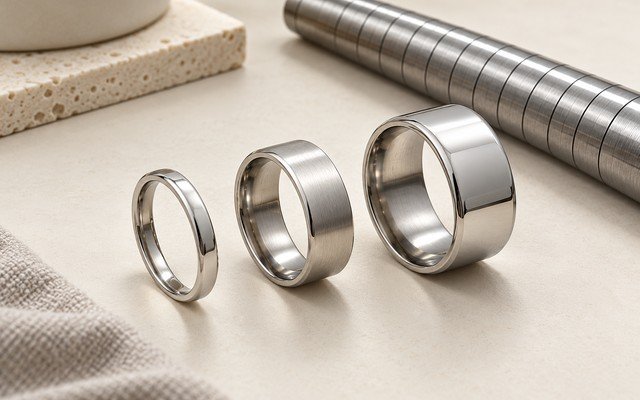
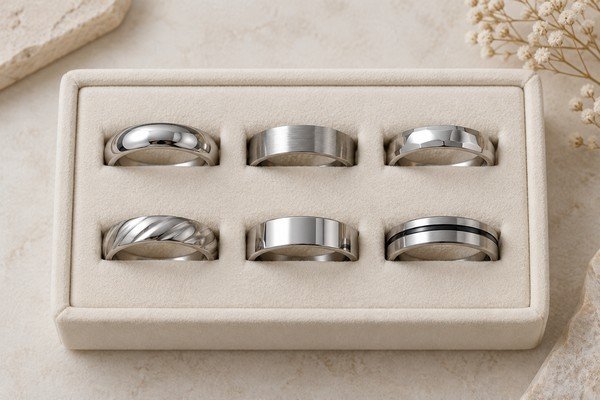
Compare Black Stainless Steel Men’s Wedding Band and Unisex Silver Brushed Dome Band when planning a band assortment. Confirm each selected profile’s finished size mapping and wearing fit before applying the same quantity breakdown.
Confirm how the ring will be measured, including the gauge and whether the inner profile affects the reading. Ask the supplier to check representative samples from the proposed range rather than assuming one successful middle size validates all sizes.
See GIA guidance on determining finger and ring sizes when preparing size references. Confirm the buyer’s size mapping on the actual finished ring profile before assigning order quantities.
Your product page, packing label and purchase order should refer to the same size mapping. A correctly manufactured ring can still generate returns if the label points to the wrong retail size.
Review band width and interior profile
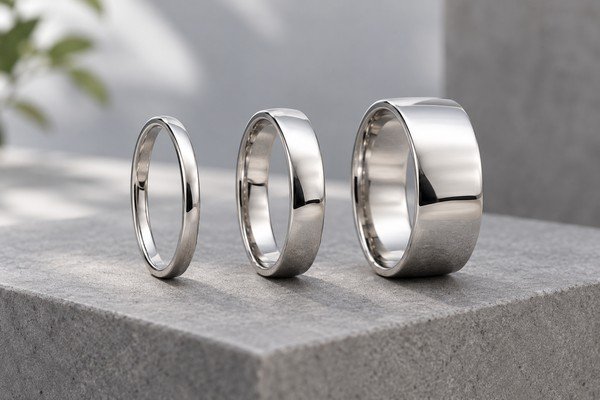
A wide band and a slim stacking ring can feel different on the same finger. Rounded interiors, edge shapes and decorative sections also affect the wearing experience. This is why approval should include the actual design, not only a generic sizing ring.
For a new collection, compare samples across the planned size range. Record feedback carefully and distinguish fit preferences from measurement errors. Avoid changing a size specification based on one person’s experience without considering the intended customers.
If the design changes from narrow to wide, revisit the size information and fit guidance. The previous sales ratio may remain useful, but it should not be treated as proof that the revised product fits identically.
Turn your assumptions into an order matrix
Create one row for every design, size and finish combination. Record the planned quantity and the reason for it. If your only evidence is a small customer survey, label that limitation clearly.
| Field | What the buyer records |
|---|---|
| Variant | Design, size system and finish |
| Demand evidence | Sales, requests or a stated trial assumption |
| Opening quantity | Units for this exact variant |
| Review trigger | Sales period or stock threshold for reassessment |
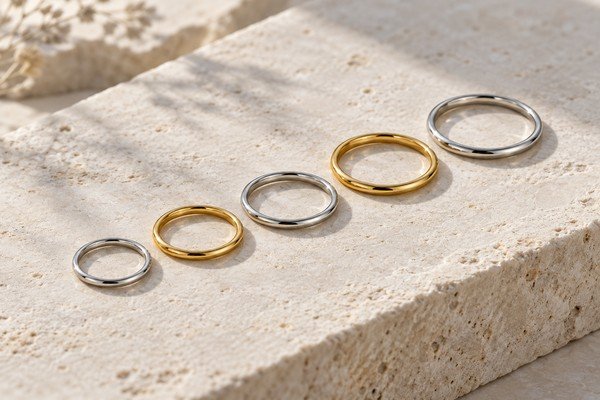
For illustration, a 300-piece order spread across five sizes and two finishes creates ten variants. An equal split gives only 30 pieces per variant. That arithmetic may look manageable, but it says nothing about whether demand will be equal.
Keep a new launch small enough to learn
If you have no relevant sales history, choose a focused range and agree the smallest practical order with the supplier. Ask which sizes share tooling and whether less common sizes change cost or lead time.
A pilot should test a defined question. You might compare demand for two finishes while keeping the design and promotion consistent. Launching many designs, sizes and price points simultaneously makes it harder to understand what caused the result.
For broader assortment planning, read our guide to starting a jewelry brand. The key is to make the first collection manageable without claiming that a small trial represents the whole market.
Interpret sales with availability in mind
Track units available, units sold, exchanges, returns and customer requests by variant. A size that sold only five units may have had just five available. A larger remaining quantity may reflect overbuying rather than a defective product.
Keep measurement complaints separate from preference-based exchanges. Ask whether the returned ring matches its labeled specification before changing the next production order.
Review the elapsed selling time as well. A size introduced late in the launch should not be compared directly with one available from day one without noting the difference.
Make replenishment part of the opening decision
Ask for reorder minimums by size and finish before placing the first order. A successful size is difficult to replenish if it requires purchasing an entire unwanted assortment again.
Reserve the approved sizing record with the supplier. On repeat orders, confirm whether the tooling, inner profile and finishing process remain unchanged. Request fresh verification when the design or production route changes.
My recommendation: buy a size plan that can be corrected. A slightly narrower opening range with clear replenishment options can be more useful than a broad range whose slow variants cannot be adjusted.
Keep demand assumptions separate from sizing approval
Use one record for the ring measurements and another for quantity allocation. A change in demand does not justify relabeling a ring that measures incorrectly. Conversely, a slow-selling size can be dimensionally correct. Review availability, exchanges and stockouts before revising the next order mix.
For open designs, apply the adjustable ring review. Test an uncertain size mix through a focused pilot order rather than presenting an untested distribution as a market standard.
Illustrative ring quantity allocation
Use these fields in your purchase order or sample review. Numerical values and IDs below are illustrative, not live product specifications, test results or confirmed commercial terms. Agree measurement methods, tolerances and acceptance criteria for your actual design.
| Field | Record or illustrative example | Verification before release |
|---|---|---|
| US 6 | 40 units — illustrative planning allocation | Confirm sizing convention and finished inner measurement |
| US 7 | 60 units — illustrative planning allocation | Use channel evidence; quantities are not a market-standard ratio |
| US 8 | 40 units — illustrative planning allocation | Total 140 units; confirm minimum per size before treating this as an order |
Ring buying questions
Is an adjustable ring a substitute for size planning?
Not automatically. It still needs a defined starting size, intended adjustment range and suitable instructions. Repeated bending should not be assumed harmless.
Should I use the same ratio for every ring?
No. Customer profile, design, band width and channel can affect demand and fit. Review each group using relevant evidence.
Send Yleryler your ring order matrix with design references, finish choices and proposed sizes so we can review the production requirements.
Images are AI-generated design illustrations. Confirm actual products and specifications against approved samples.
Can an example size allocation be used as a market standard?
No. Illustrative quantities are planning aids. Use relevant demand evidence, availability and fit data, then confirm minimums per size before releasing the order.