To start a jewelry brand, I believe you need more than a name, logo, and online store. Many founders spend too much time on visuals, then discover their products are hard to produce, price, package, or replenish. The better solution is to build a focused first collection that fits your buyer, sales channel, and supply chain.
To start a jewelry brand, define your target customer, sales channel, price range, and first product collection before you order inventory. A strong launch should be small, producible, testable, and easy to replenish. Your first goal is not to offer everything. Your goal is to prove demand with consistent quality, branding, packaging, and delivery.
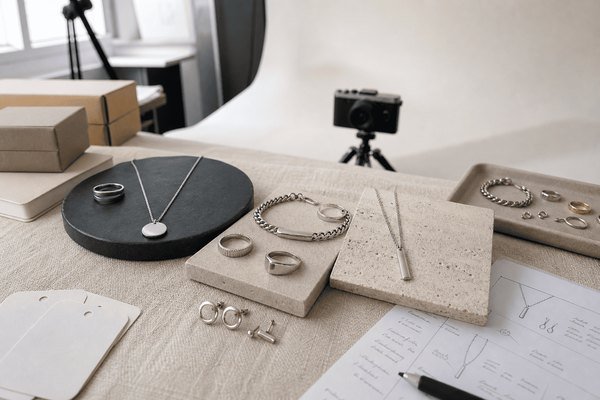
I work on the manufacturing side of stainless steel jewelry OEM/ODM, so I often see the same issue early. Buyers ask about MOQ or lowest unit price first. Those questions matter, but they do not tell us whether the launch can actually work.
How Should I Start a Jewelry Brand With a Clear Buyer and Channel?
Many new founders want to start a jewelry brand by choosing products they personally like. That can be risky. A style may look attractive, but it may not fit the buyer, sales channel, retail price, or repeat order plan. I always suggest starting with the market path first.
<p style="margin:0 0 20px;line-height:1.85;">Start assortment discussions with defined product roles, for example <a href="https://yleryler.com/product/ssn-029-womens-gold-stainless-steel-layered-necklace/">Women's Gold Stainless Steel Layered Necklace</a> for the necklace range and <a href="https://yleryler.com/product/sse-012-stainless-steel-stud-earrings/">Stainless Steel Stud Earrings</a> for the earring range. Confirm the selected samples and commercial terms before launch planning.</p>
To start a jewelry brand with less risk, choose one clear buyer group, one main sales channel, and one price band before selecting products. A jewelry line for Amazon, a supermarket, a boutique, a nonprofit event, or a fashion brand may need different designs, packaging, margins, and delivery plans.
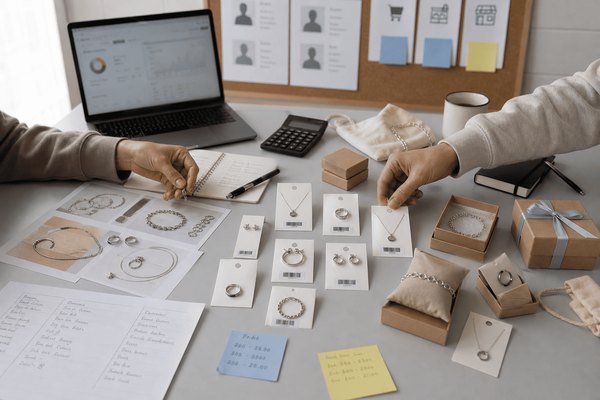
Why the buyer comes before the product
In OEM/ODM discussions, I often ask buyers a simple question: “Where will this jewelry be sold?” The answer changes almost every production decision.
For example, an e-commerce seller may care about:
- Product photos and visual consistency
- Lightweight packaging for shipping
- Clear SKU separation
- Repeatable stock for replenishment
- Surface finish that looks good in close-up images
A supermarket or wholesaler may care more about:
- Display-ready packaging
- Barcode labels
- Carton organization
- Stable pricing across repeat orders
- Broad appeal for walk-in customers
A nonprofit or event organizer may care about:
- Logo visibility
- Delivery deadline
- Simple product selection
- Budget control
- Gift packaging or message cards
These are all jewelry projects, but they are not the same brand strategy.
Match the brand idea to a real sales environment
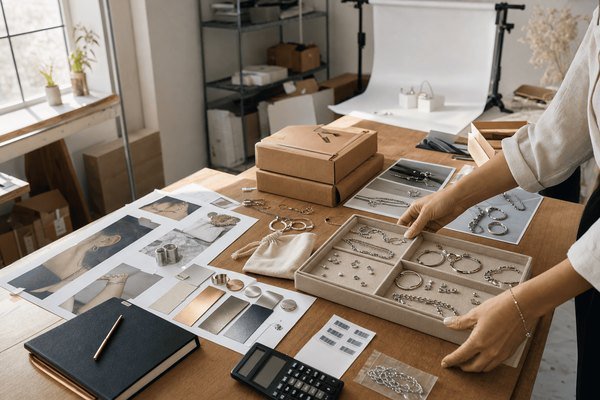
I have seen buyers prepare a large design mood board, then struggle when we discuss size, plating color, logo position, packaging, and carton requirements. The problem is not creativity. The problem is that creativity has not yet been translated into production details.
Before you contact a supplier, I suggest preparing this simple table:
| Decision Area | Key Question | Why It Matters |
|---|---|---|
| Target buyer | Who will buy the jewelry? | Style, size, and price depend on the wearer |
| Sales channel | Where will it be sold? | Packaging, labels, and logistics change by channel |
| Price range | What retail price must it fit? | Material, finish, and packaging must support margin |
| Product type | Rings, necklaces, bracelets, earrings, or sets? | Each category has different sizing and QC needs |
| Brand position | Minimal, bold, luxury-style, giftable, event-based? | Product line must feel coherent |
A narrow decision is stronger than a vague dream
A vague plan sounds like this:
“I want to launch fashionable jewelry for everyone.”
A stronger plan sounds like this:
“I want to launch a stainless steel unisex ring and pendant collection for e-commerce customers who like minimal everyday accessories, with a mid-range retail price and simple branded packaging.”
The second plan is easier to sample, quote, produce, inspect, and replenish. It also helps you avoid buying products that do not belong together.
When you start a jewelry brand, clarity protects your budget. It helps your supplier recommend realistic materials, logo methods, surface finishes, packaging styles, and production routes. It also helps you test demand without carrying too many slow-moving SKUs.
What First Collection Should I Build to Start a Jewelry Brand Safely?
It is tempting to launch with many rings, necklaces, bracelets, earrings, and seasonal designs. I understand the feeling. A broad catalog looks more professional. However, a large first launch can create high inventory pressure and make quality control harder.
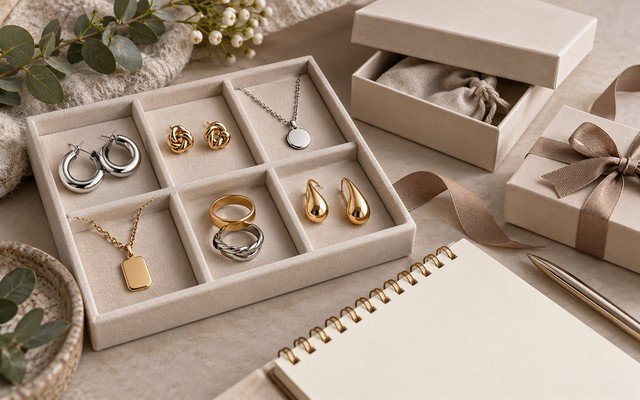
The safest way to start a jewelry brand is to build a small first collection with a clear theme, limited SKUs, and repeatable production. A focused launch helps you test style, pricing, audience response, packaging, and replenishment before you invest in a wider private-label jewelry range.
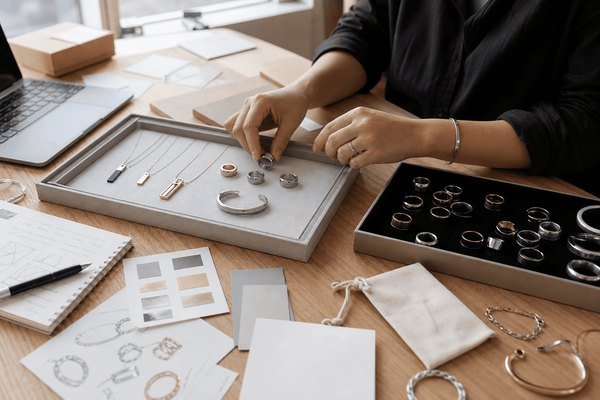
Your first collection should answer one market question
A first collection is not only a product group. It is a test. It should help you answer a specific business question, such as:
- Will customers buy minimalist stainless steel rings at this price?
- Will my audience prefer gold-tone or silver-tone finishes?
- Will branded packaging improve perceived value?
- Will this pendant design work as a gift item?
- Will a unisex jewelry line sell better than a gender-specific line?
If you launch too many different styles at once, you may not know what worked. You may sell some pieces, but you may not understand why. That makes your second order harder.
A practical first collection structure
For many new private-label jewelry projects, I like a structure similar to this:
| Collection Type | Example Structure | Why It Works |
|---|---|---|
| Minimal test line | 3–5 core designs in 1–2 finishes | Easy to compare sales response |
| Giftable line | 2 necklaces, 2 bracelets, 1 ring style | Simple for packaging and display |
| Unisex line | Rings and pendants in standard sizes | Works for broad daily-wear positioning |
| Event line | 1–3 products with logo or message card | Easier deadline and budget control |
| Wholesale starter line | 8–12 coordinated SKUs | Gives buyers variety without too much spread |
The exact number depends on your channel, budget, and product complexity. Still, the principle stays the same: start narrow enough to learn.
Avoid building a “random catalog”
One mistake I often see is mixing unrelated stock items and calling it a brand. Stock products can be useful for testing. They can reduce development time. However, a true jewelry brand needs more than a group of available items.
A first collection should share at least a few consistent elements:
- Similar design language
- Controlled material and finish choices
- Consistent logo method, if used
- Matching packaging style
- Clear retail price logic
- Repeatable QC standards
- Reorder plan for bestsellers
For example, if one bracelet is polished silver, one ring is black plated, one pendant is enamel-filled, and one necklace uses a completely different chain quality, the line may feel disconnected. Customers may not remember the brand. Buyers may not understand the offer.
Build around replenishment, not only launch
A launch order is only the first step. If a product sells well, you need to reorder it with the same size, finish, logo placement, packaging, and quality level. That is where many weak launches fail.
When I review a new inquiry, I like to know:
- Which SKUs are expected to become repeat products?
- Which products are only for seasonal or campaign use?
- Which packaging elements must stay consistent?
- Which finish colors must match future orders?
- Which documents or labels are required for export or sales?
A small first jewelry collection gives you better control over these details. It also gives your supplier a clearer production target.
How Do Materials Affect How to Start a Jewelry Brand?
Material choice can make or break your first collection. Many founders choose materials based only on appearance or unit price. That is incomplete. The material affects durability, finish options, customization, customer expectations, packaging position, and repeat production.
When you start a jewelry brand, choose materials based on your price band, target customer, product type, and customization needs. Stainless steel, brass, silver, alloy, and other materials all have different strengths. Stainless steel is often useful for durable, scalable private-label jewelry, but it is not the only option.
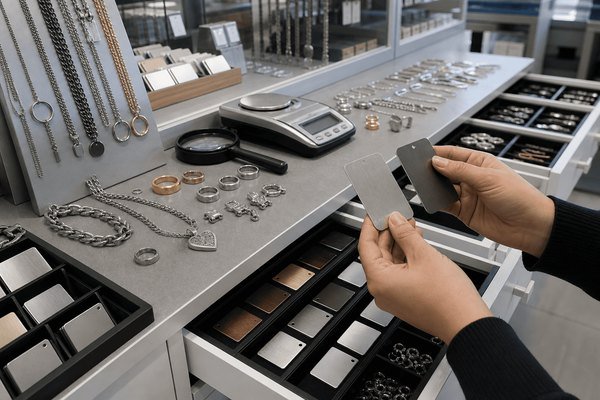
Compare materials by business fit
I specialize in stainless steel jewelry manufacturing, so I naturally see its advantages often. It can support many everyday jewelry designs, custom logos, polished or plated finishes, and scalable production. However, I do not think every brand should automatically choose stainless steel.
A fine jewelry brand may need precious metals. A very low-cost promotional item may use another material. A handmade luxury craft brand may focus on artisan techniques. The right material depends on the brand promise.
Here is a simplified comparison:
| Material | Common Strengths | Watch Points |
|---|---|---|
| Stainless steel | Durable, modern, good for OEM/ODM, suitable for many unisex styles | Some complex fine-jewelry details may require other processes |
| Brass | Flexible for shapes and plating, common in fashion jewelry | Plating quality and tarnish control matter |
| Sterling silver | Higher perceived value, good for premium positioning | Higher material cost and care expectations |
| Zinc alloy | Useful for some low-cost or promotional designs | Weight, finish, and durability must be checked |
| Titanium | Lightweight and strong for certain products | Processing and style options may be more specialized |
Stainless steel jewelry can support a practical first launch
For many e-commerce sellers, wholesalers, and private-label buyers, stainless steel jewelry is attractive because it can balance durability, customization, and production stability. It is often used for:
- Rings
- Pendants
- Necklaces
- Bracelets
- Earrings
- Unisex accessories
- Logo jewelry
- Event or organization gifts
In my factory-side work, buyers often ask whether they can add a logo, change plating color, adjust size, or create private packaging. These are practical brand-building details. Stainless steel can often support methods such as laser marking, engraving, enamel color filling, screen printing on packaging, and custom tags. The exact method depends on the design, surface, quantity, and required durability.
Material affects quality control
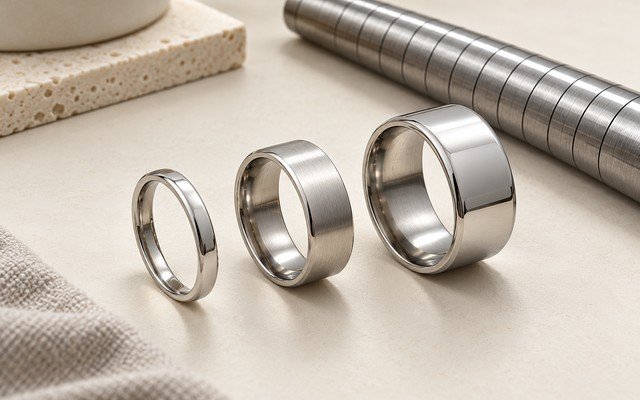
Material is not only a line in a quotation. It affects the QC checklist. For example, a stainless steel ring project may require checks for:
- Size accuracy
- Surface scratches
- Edge smoothness
- Color consistency
- Logo position
- Plating appearance, if plated
- Packaging match
- Carton labeling
A necklace project may also require chain length checks, clasp function checks, pendant alignment, and assembly inspection. A bracelet may require clasp strength and wrist fit review.
Do not choose material only by lowest cost
The cheapest material may not support your retail price or customer promise. It may also create after-sales issues if the finish, weight, or feel does not match buyer expectations.
Before choosing material, I suggest writing a short product specification:
- Product category
- Target retail price range
- Preferred material
- Finish color
- Logo requirement
- Size range
- Packaging type
- Expected order quantity
- Required delivery schedule
- Market or platform requirements you already know
This makes supplier communication much faster. It also helps you avoid changing direction after sampling, which can delay the launch.
Why Are MOQ and Unit Price Not Enough When You Start a Jewelry Brand?
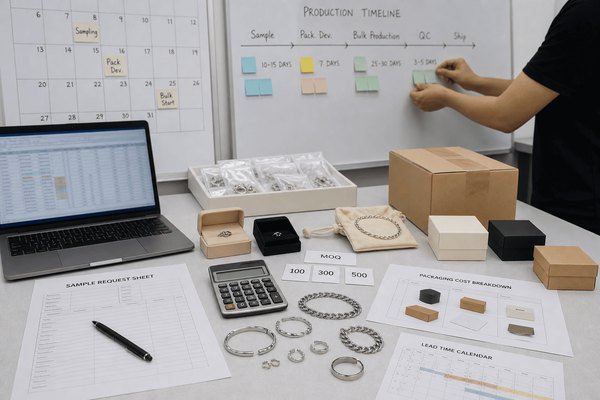
Many inquiries begin with two questions: “What is your MOQ?” and “What is your best price?” I understand why buyers ask this. Budget matters. But MOQ and unit price alone do not show the full cost, risk, or feasibility of a jewelry launch.
When you start a jewelry brand, MOQ and unit price are only part of the decision. You also need to evaluate sampling cost, logo durability, surface finish, packaging, QC standard, production lead time, repeat order stability, export documents, and delivery requirements.
MOQ depends on more than the product
MOQ is not one fixed number for every project. It can change based on:
- Product category
- Existing mold or new development
- Material choice
- Plating or surface process
- Logo method
- Packaging customization
- Color requirements
- Size range
- Production schedule
- Supplier production line arrangement
For example, a plain stock pendant with simple packaging is different from a custom-size ring with engraving, gold plating, enamel color, branded gift box, barcode label, and export carton requirements. Both may be jewelry, but they are not the same production project.
Unit price is not the same as launch cost
A lower unit price can look attractive at first. However, it may not be the best total decision if it creates weak packaging, inconsistent finish, unclear QC, or difficult replenishment.
A more complete cost view includes:
| Cost Area | Why It Matters |
|---|---|
| Sample cost | You need to confirm design, size, finish, and logo before mass production |
| Mold or development cost | Custom shapes may require tooling or development work |
| Unit product cost | This affects margin and wholesale pricing |
| Logo process cost | Engraving, laser, enamel, or printing may have different costs |
| Packaging cost | Private-label packaging can change perceived value |
| Inspection cost | QC reduces risk before shipment |
| Shipping cost | Weight, volume, and destination matter |
| Reorder cost | Bestsellers must be repeatable without surprise changes |
Sampling protects your launch
I rarely suggest skipping samples for a new custom jewelry brand. Photos and drawings help, but they cannot fully confirm feel, weight, finish, size, and logo effect.
A useful sample review should check:
- Does the product match the intended customer?
- Does the finish look right under normal light?
- Does the logo method feel durable and readable?
- Does the size fit the target market?
- Does the packaging support the retail price?
- Does the product photograph well for online sales?
- Can the supplier repeat this result in bulk?
Sampling may feel slow, but it often prevents larger problems later. A poor logo position or wrong plating tone is much easier to correct before mass production.
Lead time is part of brand planning
A launch calendar should include more than production days. It should include time for design confirmation, sample making, sample shipping, feedback, revisions, mass production, QC, packing, export preparation, and final delivery.
I avoid promising fixed lead times because every project is different. A simple repeat order can move faster than a new custom collection. A private-label project with packaging, tags, cartons, and multiple SKUs needs more coordination.
If your sales channel has a fixed launch date, tell your supplier early. This is especially important for Amazon sellers, seasonal campaigns, retail promotions, nonprofit events, and wholesale delivery windows.
How Do Logo, Packaging, and QC Help You Start a Jewelry Brand?
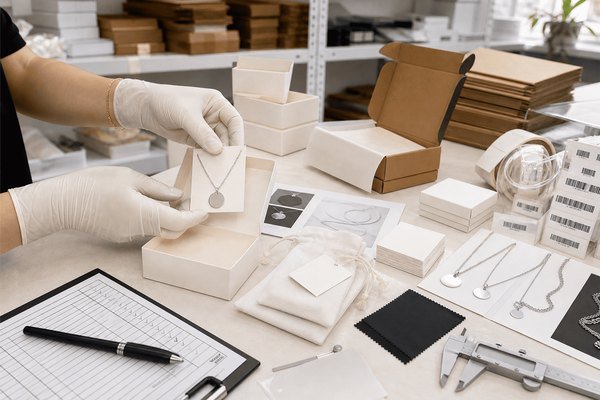
A product becomes a brand when customers recognize it, trust it, and receive the same experience again. Logo and packaging help with recognition. Quality control helps with trust. Replenishment helps with consistency. Without these pieces, a jewelry launch may feel like random stock buying.
To start a jewelry brand properly, plan logo application, packaging, labeling, QC, and repeat production together. A real private-label jewelry line needs coherent products, stable quality, suitable branding, and a replenishment process that can support future orders.
Logo method should match the product surface
Logo customization is not one universal process. The right method depends on product material, surface shape, finish, logo size, durability needs, and visual effect.
Common logo methods include:
- Laser marking: Clean and precise for many metal surfaces.
- Engraving: Good for a deeper physical mark on suitable designs.
- Enamel filling: Useful when color is part of the design.
- Screen printing: Often used on packaging, tags, or display materials.
- Embossing or hot stamping: Common for jewelry boxes, pouches, or cards.
A tiny logo on a curved ring surface is different from a large logo on a flat pendant. A brand mark on a velvet pouch is different from a laser logo on stainless steel. I often recommend testing the logo method during sampling because the real effect can differ from the artwork preview.
Packaging should fit the channel and price
Packaging is not only decoration. It affects cost, shipping volume, retail display, customer perception, and operational efficiency.
Here are common packaging options:
| Packaging Type | Best For | Notes |
|---|---|---|
| OPP bag or simple pouch | Cost-sensitive wholesale or internal packing | Low cost, less premium feeling |
| Jewelry card | Earrings, necklaces, bracelets | Good for display and branding |
| Velvet pouch | Giftable but lightweight products | Useful for e-commerce shipping |
| Paper box | Private-label and retail-ready lines | Better perceived value, more volume |
| Custom gift box | Premium or campaign launches | Higher cost and longer planning time |
| Barcode/carton labels | Supermarkets, warehouses, Amazon prep | Must match channel requirements |
If you sell online, packaging must protect the product during shipping and look good in unboxing photos. If you sell wholesale, packaging may need to be easy for store staff to count, display, and reorder. If you sell through a marketplace, you should confirm labeling and packaging requirements directly from that platform or your logistics provider.
QC turns a nice sample into a reliable order
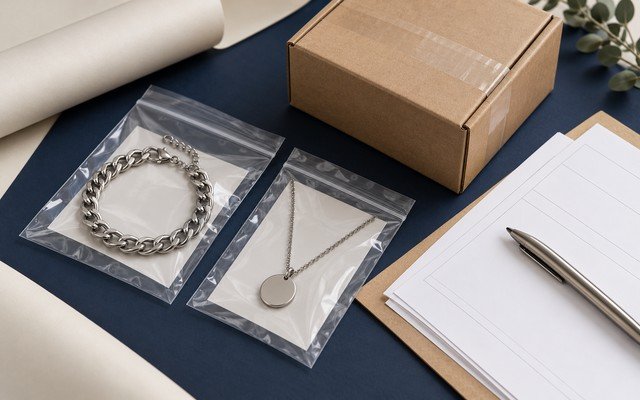
A sample can be perfect, but mass production still needs inspection. In jewelry OEM/ODM, small defects can affect customer trust quickly. Scratches, color differences, rough edges, weak clasps, wrong sizes, and misplaced logos are all avoidable problems when the QC standard is clear.
A basic QC checklist may include:
- Product quantity by SKU
- Size and measurement
- Surface finish
- Logo position and clarity
- Color consistency
- Clasp or connection function
- Stone or enamel placement, if applicable
- Packaging match
- Label and carton information
- Random inspection before shipment
The checklist should match the product. A ring, bracelet, pendant, and earring do not have the same risk points.
Branding also means repeatability
A brand is not built by one shipment. It is built when buyers can return and receive the same style, quality, and experience again.
For repeat production, keep records of:
- Product drawings or reference samples
- Material specifications
- Surface finish standards
- Logo artwork and placement
- Packaging files
- Label details
- Approved sample photos
- Carton marks and packing method
This sounds basic, but it saves time. When a bestseller needs a reorder, you do not want to rebuild every detail from memory. You want a production file that keeps the next batch consistent.
Connect your launch plan to production records
Build a focused capsule collection and use a defined pilot order to test the next buying decision. Before ordering, finalize your logo artwork and SKU and packing-list rules. Keep launch assumptions separate from confirmed supplier commitments.
Frequently Asked Questions
How much money do I need to start a jewelry brand?
The budget depends on product type, material, customization, packaging, MOQ, sampling, shipping, and sales channel. I suggest planning a test launch instead of a huge catalog. Prepare your target price range first, then ask suppliers to check what product and packaging options are realistic.
Can I start a jewelry brand with stock products?
Yes, you can use stock products to test demand, but stock products alone do not create a strong brand. You still need a coherent product line, consistent packaging, quality standards, logo plan, and replenishment strategy. Otherwise, the launch may feel like a collection of unrelated items.
Is stainless steel good for a new jewelry brand?
Stainless steel can be a strong option for many new brands because it is durable, modern, and suitable for many OEM/ODM customization methods. It works well for many rings, pendants, bracelets, and unisex designs. However, the best material depends on your customer, price point, and brand positioning.
Should I focus on MOQ or product quality first?
You should consider both, but MOQ alone is not enough. A very low MOQ may still fail if the product quality, logo method, packaging, or delivery plan does not fit your launch. I suggest confirming samples, specifications, QC standards, and reorder feasibility before placing a larger order.
What should I prepare before contacting a jewelry OEM/ODM supplier?
Prepare your target customer, sales channel, product ideas, price range, material preference, logo needs, packaging plan, expected quantity, and launch timeline. If you have reference images or drawings, include them. Clear information helps the supplier assess feasibility and suggest practical production options.
<section data-yleryler-review="2026-10-buyer-spec"><h2 style="margin:38px 0 16px;line-height:1.35;">First collection launch worksheet</h2><p style="margin:0 0 20px;line-height:1.85;">Use these fields in your purchase order or sample review. Numerical values and IDs below are illustrative, not live product specifications, test results or confirmed commercial terms. Agree measurement methods, tolerances and acceptance criteria for your actual design.</p><div style="overflow-x:auto;margin:26px 0;"><table style="width:100%;min-width:540px;border-collapse:collapse;font-size:15px;line-height:1.65;"><thead><tr><th style="padding:12px;text-align:left;vertical-align:top;border:1px solid #ddd;background:#f2f5f5;" scope="col">Field</th><th style="padding:12px;text-align:left;vertical-align:top;border:1px solid #ddd;background:#f2f5f5;" scope="col">Record or illustrative example</th><th style="padding:12px;text-align:left;vertical-align:top;border:1px solid #ddd;background:#f2f5f5;" scope="col">Verification before release</th></tr></thead><tbody><tr><td style="padding:12px;text-align:left;vertical-align:top;border:1px solid #ddd;">Buyer and channel</td><td style="padding:12px;text-align:left;vertical-align:top;border:1px solid #ddd;">Named customer group and planned selling channel</td><td style="padding:12px;text-align:left;vertical-align:top;border:1px solid #ddd;">Define product requirements before selecting an assortment</td></tr><tr><td style="padding:12px;text-align:left;vertical-align:top;border:1px solid #ddd;">Inventory exposure</td><td style="padding:12px;text-align:left;vertical-align:top;border:1px solid #ddd;">Quantity by variant × quoted product cost</td><td style="padding:12px;text-align:left;vertical-align:top;border:1px solid #ddd;">Add development and packaging separately; preserve the total opening budget</td></tr><tr><td style="padding:12px;text-align:left;vertical-align:top;border:1px solid #ddd;">Launch decision</td><td style="padding:12px;text-align:left;vertical-align:top;border:1px solid #ddd;">Sample release, stock-ready date and pilot question</td><td style="padding:12px;text-align:left;vertical-align:top;border:1px solid #ddd;">Use the first sales period to inform a SKU-level reorder</td></tr></tbody></table></div></section>
Conclusion
To start a jewelry brand, I would focus less on building a huge catalog and more on creating a small, producible, testable first collection. Your buyer, channel, price point, material, logo method, packaging, QC, and replenishment plan all shape the real launch.
If you are preparing a private-label or OEM/ODM jewelry project, gather your target channel, first product ideas, price range, logo and packaging needs, and expected launch plan before asking a supplier to assess feasibility. For stainless steel jewelry OEM/ODM support, you can contact us at request a jewelry launch quotation or email billh@yleryler.com.
<p style="margin:0 0 20px;line-height:1.85;"><small>Images are educational concepts, not evidence of actual factory operations, stock or inspected customer orders. Confirm specifications and performance using identified finished samples and applicable documents.</small></p>