A private label jewelry manufacturer can make or break a stainless steel jewelry project before the first bulk order leaves the factory. Many buyers start with a price target, but hidden details quickly create delays, quality gaps, and packaging mistakes. The safer path is to judge the full production system, not only the unit quote.
A private label jewelry manufacturer should manage product selection or development, stainless steel material control, logo application, packaging, labeling, sampling, mass production, QC, and export handover. The best choice is not always the cheapest supplier. It is the manufacturer that can deliver consistent brand-ready jewelry at a realistic total delivered cost.
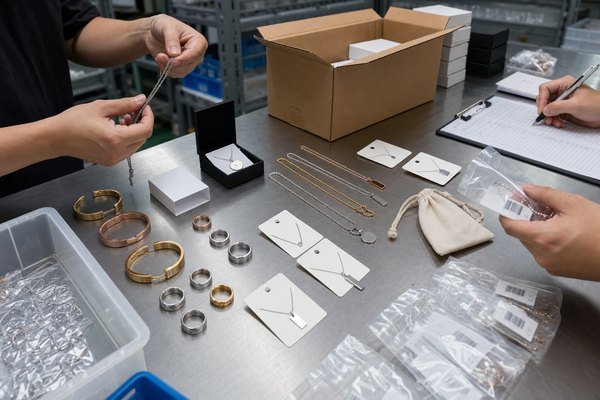
In my daily OEM/ODM project discussions, I often see buyers focus on two questions first: “Can you add my logo?” and “What is the lowest price?” Those questions matter, but they are only the beginning. A real private label project depends on many connected decisions.
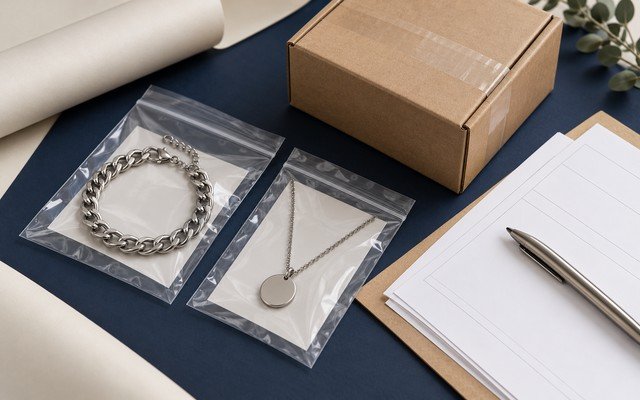
<p style="margin:0 0 20px;line-height:1.85;"><a href="https://yleryler.com/product/ssb-025-custom-engraved-stainless-steel-bracelet/">Custom Engraved Stainless Steel Bracelet</a> is a starting option for a private-label branding brief. State the requested engraving position and retail packaging, then approve the actual marked sample.</p>
What Should a Private Label Jewelry Manufacturer Actually Handle?
A private label jewelry manufacturer should do more than produce a blank ring, bracelet, necklace, or pendant. If the supplier only treats private label as “add a logo,” the buyer may face mismatched packaging, unclear SKU labels, poor carton planning, and unstable reorders later.
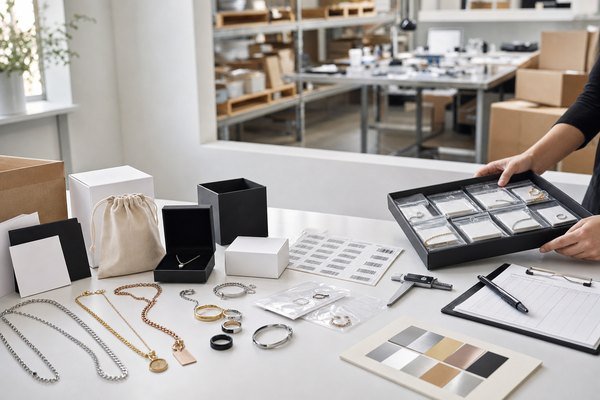
A capable manufacturer should coordinate the full brand-ready production process. This includes product confirmation, material selection, logo method, packaging design execution, labeling, cartons, sampling, bulk production, quality inspection, and export preparation. Each step affects the final delivered result.
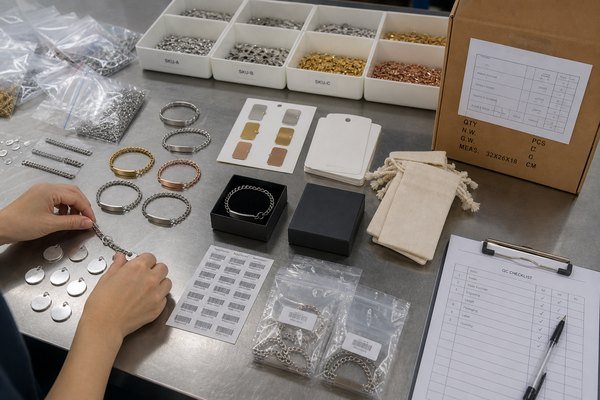
Private label is a production system, not a sticker
In stainless steel jewelry OEM/ODM work, private label production usually includes several connected steps. I normally explain it to buyers as a chain. If one link is weak, the final order can still fail even when the jewelry itself looks acceptable.
A typical project may include:
Product selection or development
The buyer may choose existing stainless steel jewelry styles, request changes, or provide drawings.Material and finish confirmation
The project may require 316L stainless steel, 304 stainless steel, polished finish, brushed finish, plated color, or enamel detail.Logo method selection
Options may include laser engraving, mechanical engraving, screen printing, enamel logo, custom tag, or packaging logo.Sample approval
The buyer confirms shape, size, surface finish, logo position, packaging, and SKU information.Mass production
The factory follows the approved sample and production file.Quality control
The team checks size, finish, logo clarity, packaging protection, quantity, and carton marks.Export handover
The goods are prepared for forwarder pickup, air shipment, sea shipment, or other agreed delivery terms.
Why this matters for B2B buyers
A supermarket buyer, Amazon seller, wholesaler, or new brand founder usually has different risks.
| Buyer type | Common concern | Manufacturer capability needed |
|---|---|---|
| Amazon seller | SKU accuracy, packaging, barcode readiness | Label control and carton organization |
| Supermarket buyer | Batch consistency and delivery timing | Stable production planning and QC |
| Wholesaler | Competitive cost and repeat supply | Efficient production and reorder management |
| Brand founder | Logo, packaging, product feel | Sampling support and private label execution |
| Event or nonprofit buyer | Deadline and quantity accuracy | Clear timeline and export coordination |
I once discussed a project where the buyer was satisfied with the pendant price, but the packaging requirement changed the whole cost structure. The jewelry itself was simple. The private label packaging, insert card, barcode label, and carton sorting created the real workload.
That is why I recommend asking this question early:
“Can this supplier manage the whole private label workflow, or only one part of it?”
A good private label jewelry manufacturer should give practical feedback before sampling. The factory does not need to promise market success. However, it should identify production limits, logo risks, packaging requirements, and delivery constraints before the buyer commits to bulk production.
How Do You Compare Quotes From a Private Label Jewelry Manufacturer?
A low quote from a private label jewelry manufacturer can look attractive, but it may exclude key private label costs. If the quote does not include logo work, packaging, labeling, quality checks, carton details, or export preparation, the final cost may increase after sampling.
Buyers should compare quotes by total delivered private label cost, not only unit jewelry price. A complete quote should clarify product cost, logo cost, packaging cost, MOQ, sampling fee, tooling if needed, inspection standard, carton method, and delivery or export terms.
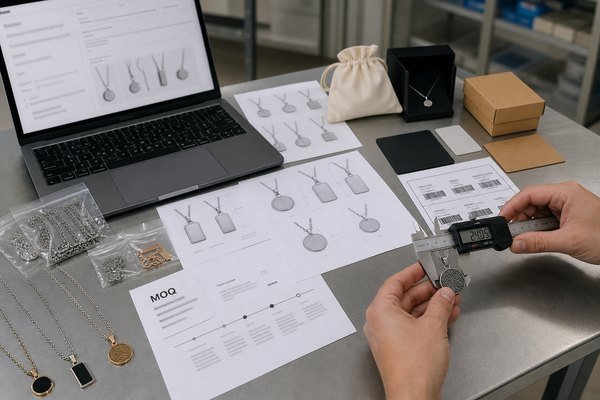
The lowest unit price is not always the lowest project cost
In private label project discussions, I often see buyers compare suppliers using a single number: the unit price. That method is easy, but it can be misleading. Stainless steel jewelry private label orders include visible costs and hidden handling costs.
A quote may look low because it excludes:
- Custom logo setup
- Laser engraving or printing charges
- Mold or tooling adjustment
- Custom packaging
- Inner bags or protective materials
- Hang tags, insert cards, or barcode labels
- SKU sorting
- Carton marks
- Extra QC requirements
- Export document preparation
- Domestic delivery to forwarder
- Shipping or freight-related coordination
A better question is:
“What will this order cost when it is fully brand-ready and ready for export?”
Quote comparison checklist
Before comparing two manufacturers, I suggest buyers put the quotes into one table.
| Cost item | Supplier A | Supplier B | Notes to confirm |
|---|---|---|---|
| Jewelry unit price | Material, size, finish included? | ||
| Logo cost | Laser, engraving, printing, enamel? | ||
| Packaging cost | Box, pouch, card, polybag? | ||
| Labeling cost | Barcode, SKU label, carton label? | ||
| Sampling fee | Refundable or not? | ||
| Tooling/mold cost | Needed for custom design? | ||
| MOQ | Per style, per color, or total order? | ||
| QC standard | What defects are checked? | ||
| Delivery terms | EXW, FOB, DDP, forwarder pickup? |
MOQ and SKU complexity change the real price
Private label stainless steel jewelry projects often include several styles, sizes, colors, or packaging versions. That creates SKU complexity. A simple order of 1,000 identical bracelets is different from 1,000 pieces split across 20 SKUs.
For example:
- 5 ring sizes × 2 colors × 2 packaging versions = 20 SKUs
- 10 necklace styles × 3 logo positions = 30 production variations
- 1 pendant design × 1 logo × 1 box = simple production flow
The factory must organize materials, production lines, inspection, packaging, and cartons around these details. More SKUs usually mean more handling time, even if the total quantity looks large.
What a realistic quote should tell you
A serious private label jewelry manufacturer should be willing to clarify assumptions. The supplier may not know every final cost during the first message, but it should ask practical questions.
A useful quote should explain:
- What product specification is included
- Which stainless steel grade is planned
- Which finish or color treatment is included
- Which logo method is quoted
- Which packaging is included
- What MOQ applies
- What sampling timeline is expected
- What bulk lead time is estimated
- What delivery term is used
I do not recommend choosing a supplier only because the first price looks lower. In many cases, a slightly higher transparent quote is safer than a low quote that expands later. The goal is not to overpay. The goal is to avoid surprise costs and production confusion.
What Quality Checks Matter Most for Stainless Steel Private Label Jewelry?
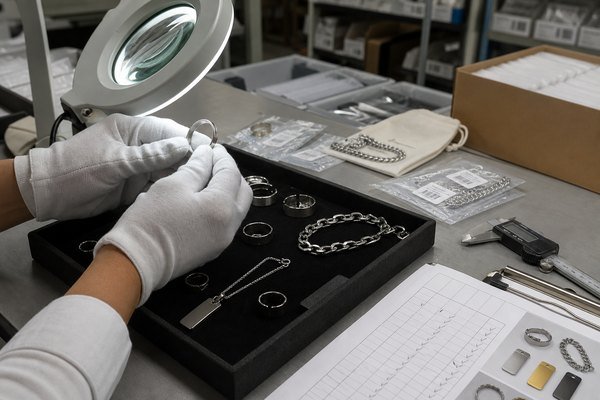
A private label jewelry manufacturer should check more than whether the product “looks good.” Stainless steel jewelry has real quality variables, including material consistency, sizing, surface finish, plating or color treatment, logo clarity, packaging protection, and batch consistency.
The most important checks include material confirmation, dimensional inspection, surface finish review, logo position and durability, plating or color consistency if used, packaging protection, quantity accuracy, and final carton verification. These checks reduce disputes before shipment.
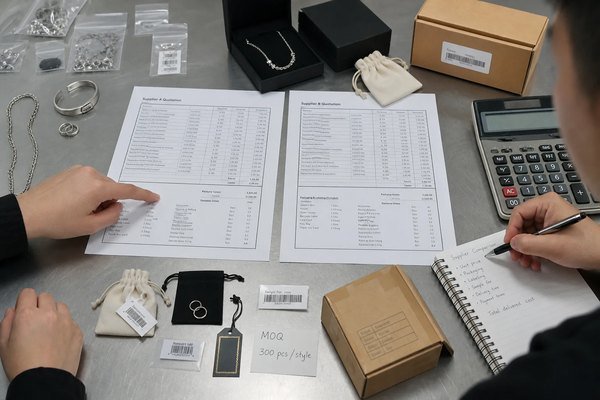
Stainless steel jewelry still has quality variables
Some buyers assume stainless steel jewelry is simple because it is durable and widely used. Stainless steel is a strong material, but private label jewelry still needs careful control.
Common quality points include:
- Material grade: 304 and 316L stainless steel have different use cases and cost levels.
- Surface finish: Polished, brushed, matte, sandblasted, and plated finishes require different controls.
- Sizing: Rings, bracelets, chains, and bangles must match agreed measurements.
- Edge finishing: Sharp or rough edges can create customer complaints.
- Logo clarity: Laser engraving, printing, and enamel all have different limitations.
- Color consistency: Gold, black, rose gold, or rainbow plating needs batch control.
- Packaging protection: Jewelry can scratch during transport if packaging is weak.
- Batch matching: Reorders should stay close to the approved sample.
Practical QC points I watch in factory production
In my factory work, I treat QC as a staged process. Final inspection is important, but it should not be the only inspection. If the team waits until the last day to find problems, the buyer may lose time.
A practical QC flow may include:
Incoming material check
The team confirms the stainless steel material and related components before production.Pre-production sample confirmation
The approved sample becomes the reference for size, finish, logo, and packaging.In-process inspection
The factory checks surface finish, forming, polishing, and logo work during production.Packaging inspection
The team confirms boxes, pouches, cards, labels, barcodes, and protection method.Final random inspection
The finished goods are checked before carton sealing and export handover.
Common quality risks in private label jewelry orders
| Risk | Why it happens | How to reduce it |
|---|---|---|
| Logo is too light | Wrong engraving depth or surface finish | Confirm sample and logo method |
| Color varies by batch | Plating process difference | Use approved color sample and batch check |
| Rings have size variation | Tooling or measurement control issue | Confirm size tolerance before bulk |
| Packaging scratches products | Weak inner protection | Add pouch, film, foam, or divider |
| SKU labels are mixed | Too many variations without clear files | Use SKU list and carton plan |
| Carton marks are wrong | Late export instruction | Confirm shipping marks before packing |
Logo method affects both appearance and durability
Buyers often ask which logo method is “best.” I usually answer that the best method depends on the product, finish, target cost, and branding style.
Here is a simple comparison:
| Logo method | Best for | Notes |
|---|---|---|
| Laser engraving | Rings, pendants, bracelets, metal tags | Durable and clean, but contrast depends on surface |
| Mechanical engraving | Deeper logo effect | May cost more and need stable surface area |
| Screen printing | Packaging, cards, some flat surfaces | Good for color, but durability varies |
| Enamel logo | Strong visual effect | Needs more process control and may affect MOQ |
| Custom tag | Necklaces, bracelets, packaging | Flexible for brand identity |
A reliable private label jewelry manufacturer should explain trade-offs clearly. For example, a very small logo may not be readable after engraving. A curved surface may not suit screen printing. A dark plating finish may need testing before logo approval.
Quality control does not remove every possible risk. However, it makes the risk visible earlier. That is valuable for B2B buyers because late corrections cost more than early corrections.
What Information Should You Send a Private Label Jewelry Manufacturer Before Sampling?
A private label jewelry manufacturer can give better pricing, sampling advice, and lead time estimates when the buyer sends clear inquiry information. Vague messages usually create back-and-forth questions, slow quotations, and inaccurate early pricing.
Before sampling, buyers should send product type, reference photos or drawings, target quantity, expected MOQ, stainless steel grade if known, logo file, logo method preference, packaging style, label requirements, target market or channel, delivery deadline, and reorder plan.
A better inquiry saves time for both sides
I understand why many buyers send short first messages. They may still be comparing suppliers. They may not know the exact product specification yet. That is normal. However, a better inquiry helps the factory respond with fewer assumptions.
A weak inquiry may look like this:
“Can you make private label jewelry? Please send best price.”
That message is difficult to quote. The factory does not know the product, quantity, material, logo, packaging, or timeline.
A stronger inquiry may look like this:
“We need 1,000 pieces of stainless steel pendant necklaces for an Amazon launch. We want laser logo on the pendant back, custom logo box, barcode label, and delivery to our forwarder in Ningbo within 45 days if possible. Please advise MOQ, sample cost, and bulk quote.”
This second inquiry gives the supplier enough information to respond with a realistic plan.
Buyer inquiry checklist
Before contacting a private label jewelry manufacturer, I suggest preparing these details:
- Product type: ring, bracelet, necklace, pendant, earring, chain, bangle, keychain jewelry accessory
- Reference style: photo, drawing, sample, or catalog item number
- Material request: 304 stainless steel, 316L stainless steel, or factory recommendation
- Finish: polished, matte, brushed, gold plated, black plated, rose gold, enamel
- Logo file: AI, PDF, SVG, or high-resolution image
- Logo position: product body, clasp, tag, card, box, pouch, carton
- Packaging: OPP bag, velvet pouch, paper card, jewelry box, gift box, custom carton
- Labeling: barcode, SKU, country label, warning label, size label
- Quantity: total order and quantity per style or SKU
- Target market: Amazon, supermarket, wholesale, event, nonprofit, brand website
- Timeline: sample deadline, bulk order deadline, launch date
- Delivery requirement: EXW, FOB, forwarder pickup, air shipment, sea shipment
- Reorder plan: one-time project or long-term supply
Why the target channel matters
The manufacturer does not need to design your whole brand strategy. However, the sales channel changes production requirements.
For example:
- Amazon sellers often need barcodes, SKU labels, individual packaging, and carton organization.
- Supermarkets may require clean packaging, carton marks, product safety documents, or consistent assortment packing.
- Wholesalers may focus on mixed styles, bulk packaging, and price stability.
- Event organizers may care most about deadline, logo visibility, and quantity accuracy.
- Brand founders may prioritize sample appearance, packaging feel, and reorder consistency.
The more the factory understands the channel, the better it can prevent production mistakes.
What to confirm before approving the sample
Sampling is not only about seeing whether the jewelry looks attractive. Sampling should confirm the full private label plan.
Before approving a sample, buyers should check:
- Product size and weight
- Material and finish
- Logo position, size, and clarity
- Packaging material and print quality
- Barcode or label placement
- Color difference from reference
- Surface scratches or sharp edges
- Carton packing method
- Bulk production tolerance
- Estimated mass production timeline
I usually recommend that buyers take photos and notes during sample review. A written approval file reduces later misunderstandings. It also helps the factory team follow the approved standard during mass production.
A good private label stainless steel jewelry project starts before production. It starts with clear communication.
How Can You Build Reorder Stability With a Private Label Jewelry Manufacturer?
A private label jewelry manufacturer should support more than one successful launch order. If the first order sells well but the reorder changes in finish, size, logo effect, or packaging, the buyer may lose customer trust and waste time correcting preventable problems.
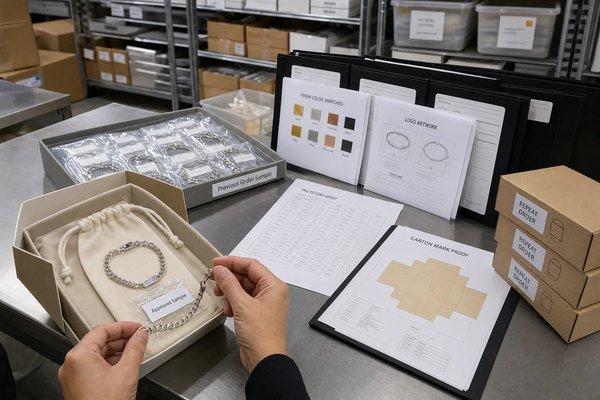
Reorder stability comes from approved samples, clear production files, documented materials, fixed logo standards, packaging specifications, SKU records, QC notes, and honest communication about any process changes. A stable system helps future orders match the first successful batch.
Reorders need documentation, not memory
Many buyers think the first order is the hardest. In some ways, that is true. The first order requires development, sampling, packaging setup, and approval. However, reorders also need careful control.
If the factory relies only on memory, small differences can appear:
- The gold tone may look warmer or cooler.
- The logo may move slightly.
- The jewelry box may use a different paper thickness.
- The chain length may vary.
- The barcode label may use a different layout.
- The carton assortment may change.
These details may seem small inside the factory. They may be serious for a buyer who sells through a controlled channel.
What should be recorded after the first order
For better reorder stability, I like to keep clear project records. Buyers should also keep their own files.
Useful records include:
| Record type | Why it matters |
|---|---|
| Approved product sample | Main reference for future production |
| Material specification | Keeps stainless steel grade and components consistent |
| Finish sample or color card | Helps control plating or surface treatment |
| Logo artwork file | Prevents size, position, or format errors |
| Packaging dieline and print file | Keeps boxes, cards, and labels consistent |
| SKU list | Prevents packing and labeling mistakes |
| Carton mark file | Helps export and warehouse handling |
| QC standard | Defines acceptable and unacceptable defects |
Long-term cooperation does not mean no changes
Even with good records, some changes can happen. Raw material costs may move. Packaging suppliers may adjust paper stock. Plating batches may have slight variation. Shipping conditions may change. A responsible manufacturer should not hide these issues.
Instead, the factory should communicate early when changes may affect the order. The buyer should also inform the factory early when the reorder differs from the last batch.
Good reorder communication includes:
- “Same as last order” plus order number
- Any changed quantity per SKU
- Any updated logo or packaging files
- Any new barcode labels
- Any new delivery deadline
- Any new target market requirement
- Any updated inspection requirement
A serious private label jewelry manufacturer should welcome this level of detail. It may feel slower at first, but it prevents more problems later.
In my experience, buyers who build a stable supplier file usually reorder more smoothly. They do not need to explain everything again from zero. The factory also has a clearer standard to follow. That is one of the practical advantages of long-term OEM/ODM cooperation.
Keep branding, packing and replenishment connected
Approve the mark at its actual size with the logo handoff guide. Review the complete sales unit through the packaging checklist, and preserve the accepted version in the reorder record. Record any substitution as a proposed change rather than assuming private labeling makes every component interchangeable.
Frequently Asked Questions
What is the difference between OEM and private label jewelry?
OEM usually means the factory produces jewelry according to the buyer’s design or specification. Private label jewelry focuses on selling products under the buyer’s brand, often with custom logo, packaging, labels, and cartons. Many stainless steel jewelry projects use both OEM and private label services together.
How much MOQ should I expect for stainless steel private label jewelry?
MOQ depends on product type, material, finish, logo method, packaging, and SKU complexity. Existing stainless steel jewelry styles may allow more flexible quantities. Fully custom designs, plated colors, enamel work, or custom packaging usually require higher MOQ because setup and production handling increase.
Should I choose laser engraving or printed logo for stainless steel jewelry?
Laser engraving is usually better for durable logos on stainless steel products. Printing can work for packaging, cards, or some flat surfaces, but it may not suit every jewelry surface. The best choice depends on logo size, product shape, finish, target look, and budget.
Why does custom packaging increase the total private label cost?
Custom packaging adds material cost, printing cost, MOQ, storage, packing labor, label control, and sometimes longer lead time. It also affects carton size and shipping volume. Buyers should include packaging in the total delivered private label cost, not treat it as a minor extra.
What should I prepare before asking for a quotation?
You should prepare product photos or drawings, quantity, stainless steel grade if known, logo file, logo position, packaging idea, label requirements, target channel, delivery deadline, and shipping preference. Clear information helps the manufacturer quote more accurately and recommend a realistic sampling plan.
<section data-yleryler-review="2026-10-buyer-spec"><h2 style="margin:38px 0 16px;line-height:1.35;">Private-label scope confirmation</h2><p style="margin:0 0 20px;line-height:1.85;">Use these fields in your purchase order or sample review. Numerical values and IDs below are illustrative, not live product specifications, test results or confirmed commercial terms. Agree measurement methods, tolerances and acceptance criteria for your actual design.</p><div style="overflow-x:auto;margin:26px 0;"><table style="width:100%;min-width:540px;border-collapse:collapse;font-size:15px;line-height:1.65;"><thead><tr><th style="padding:12px;text-align:left;vertical-align:top;border:1px solid #ddd;background:#f2f5f5;" scope="col">Field</th><th style="padding:12px;text-align:left;vertical-align:top;border:1px solid #ddd;background:#f2f5f5;" scope="col">Record or illustrative example</th><th style="padding:12px;text-align:left;vertical-align:top;border:1px solid #ddd;background:#f2f5f5;" scope="col">Verification before release</th></tr></thead><tbody><tr><td style="padding:12px;text-align:left;vertical-align:top;border:1px solid #ddd;">Product baseline</td><td style="padding:12px;text-align:left;vertical-align:top;border:1px solid #ddd;">Stock selection or developed design</td><td style="padding:12px;text-align:left;vertical-align:top;border:1px solid #ddd;">Identify what is already established and what needs a new sample</td></tr><tr><td style="padding:12px;text-align:left;vertical-align:top;border:1px solid #ddd;">Branding</td><td style="padding:12px;text-align:left;vertical-align:top;border:1px solid #ddd;">Logo revision, marking method and packed-unit artwork</td><td style="padding:12px;text-align:left;vertical-align:top;border:1px solid #ddd;">Approve real-size proof and complete finished pack</td></tr><tr><td style="padding:12px;text-align:left;vertical-align:top;border:1px solid #ddd;">Repeat supply</td><td style="padding:12px;text-align:left;vertical-align:top;border:1px solid #ddd;">SKU-level minimums and change-control owner</td><td style="padding:12px;text-align:left;vertical-align:top;border:1px solid #ddd;">Keep component and packaging references with the replenishment brief</td></tr></tbody></table></div></section>
Conclusion
Choosing a private label jewelry manufacturer is a supplier capability decision, not only a price comparison. The right partner should help control stainless steel product consistency, logo execution, packaging accuracy, QC, delivery planning, and reorder stability.
A clear inquiry will always lead to a clearer solution. If you are preparing a stainless steel private label jewelry project, send your product details, logo needs, packaging requirements, target quantity, and timeline to request a detailed private-label jewelry quotation or email billh@yleryler.com so I can review the project and suggest a realistic OEM/ODM plan.
<p style="margin:0 0 20px;line-height:1.85;"><small>Images are educational concepts, not evidence of actual factory operations, stock or inspected customer orders. Confirm specifications and performance using identified finished samples and applicable documents.</small></p>