A pendant and a chain may each meet their separate specifications but fail when assembled. The chain can fit through the bail while its end fitting cannot, or the pendant may rotate because the opening and attachment position were chosen only for appearance. For a jewelry brand, this becomes an avoidable assembly problem. Start the design discussion with the complete necklace, including the connector that must pass through the pendant.
Specify a pendant bail by its usable internal opening, passage path, attachment position and compatibility with the finished chain end. Test the actual assembled necklace before approval; chain width alone is not enough to define the required opening.
Map the complete passage path
Lay out the chain, clasp, end ring, extension and pendant before choosing dimensions. Identify which component must pass through the bail during assembly or consumer replacement. Its widest point may be larger than the chain itself. An oval fitting also needs clearance in the direction in which it is inserted, not simply a matching headline width.
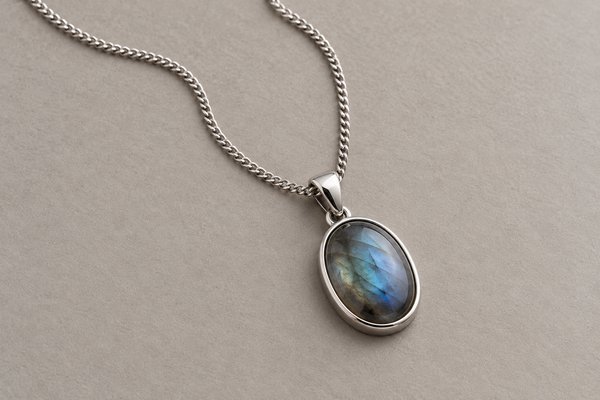
For a pendant such as Women’s Silver Stainless Steel Teardrop Pendant Necklace, send the intended finished chain end with the sample request so passage through the bail can be checked on the actual combination.
Request the internal dimensions at the narrowest usable point. A decorative opening may look generous from the front while tapering behind the stone frame. Use the physical finished sample to confirm the path. Do not assume that a pre-polishing measurement represents the final opening, especially when the bail is small or the finishing process changes its edges.
See NIST guidance on metrological traceability for measurement background. Record the narrowest usable bail opening and test passage with the actual finished chain end.
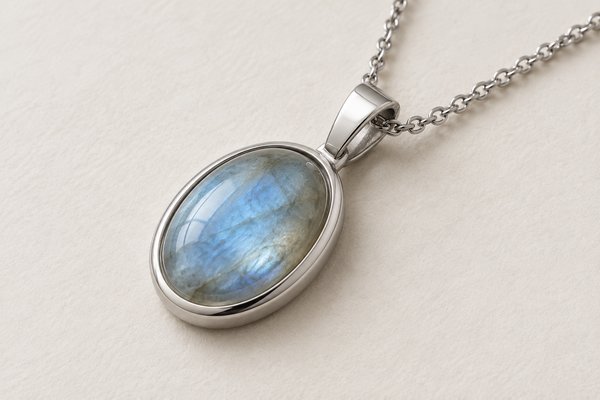
Choose how the pendant should hang
Bail position changes balance. An integrated bail, separate moving bail and rear-mounted loop can place the chain at different distances from the pendant body. Consider front appearance, side profile and whether the pendant should sit centrally. A visually hidden attachment is not automatically the best option if it causes an unwanted tilt.
Compare the necklace on a display form and laid flat. Note whether the pendant returns to its intended position after gentle movement. A gemstone, thick frame or asymmetric shape can change how the piece hangs. Describe the desired result in the approval record rather than telling the supplier only to make the bail smaller or more elegant.
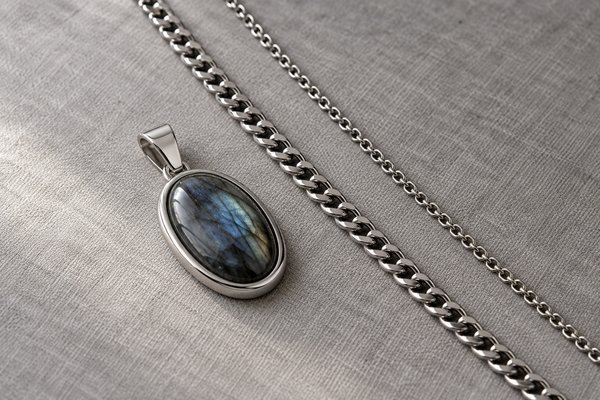
Check contact surfaces and movement
The inside of the bail should be inspected as carefully as the visible front. Look for sharp edges, rough transitions and spots where the chain catches. A chain that moves smoothly on a sample bench may behave differently with a heavy pendant, so evaluate the intended pairing. Do not extrapolate the result to every chain style in your catalogue.
If a necklace is sold with interchangeable pendants, list the compatible chain families and their end fittings. Keep incompatible combinations out of the product brief. A supplier can then develop around a defined system instead of an unspecified promise of universal fit. This also gives your customer-service team a clear answer when a retailer asks about replacement chains.
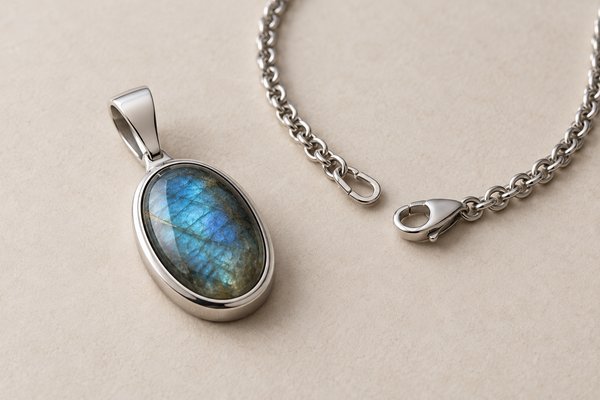
Approve the finished assembly as one SKU
Send the manufacturer the actual chain or an agreed reference sample, together with its drawing where available. Record the chain source if another supplier provides it. Ask who is responsible for assembly and who checks passage through the bail. Otherwise, two factories may each approve their own component while nobody approves the complete necklace.
Retain a finished assembled sample with the pendant revision, chain specification and packaging record. If the bail changes, review whether the chain and retail description also need updating. For repeat orders, compare the usable opening and hanging position, not just the external silhouette. Your reference should make it easy to reproduce the approved combination.
A practical buyer exercise
Use a simple compatibility trial before committing to tooling. Take the proposed pendant and each chain you intend to sell with it, then document assembly, free movement and front-facing position.
Photograph the chain end beside the bail before insertion so the reason for the chosen opening remains visible. If a connector cannot pass, decide whether to enlarge the bail, alter the connector or assemble the necklace in another controlled way. Compare those choices for appearance and serviceability. Avoid fixing one sample by opening a ring unless that is the approved assembly method for the commercial product.
Pendant bail compatibility worksheet
| Item | Evidence to keep |
|---|---|
| Bail opening | Narrowest usable internal dimensions and passage direction |
| Chain end | Widest component that must pass through during assembly |
| Movement | Catching points and hanging position on the actual pairing |
| Release | Approved pendant revision and compatible chain/end-fitting references |
Use the CAD review guide when the opening or attachment position changes. Keep the tested pairing in the reorder record instead of approving a pendant and chain independently.
Bail passage measurement example
Use these fields in your purchase order or sample review. Numerical values and IDs below are illustrative, not live product specifications, test results or confirmed commercial terms. Agree measurement methods, tolerances and acceptance criteria for your actual design.
| Field | Record or illustrative example | Verification before release |
|---|---|---|
| Usable opening | Internal width and height in mm | Measure narrowest relevant passage after finishing |
| Largest passing part | End-cap or end-ring width and depth | Include orientation and attachment components; chain width alone is insufficient |
| Fit result | Actual chain ID + bail sample ID | Record passage without force, resting orientation and smooth contact |
Buyer FAQ
Should the bail opening match the chain width exactly?
No. Allow for the actual connector shape, insertion direction and movement. Determine clearance through a finished sample review.
Can one bail work with every necklace?
Only a defined range can be verified. Record the compatible chain styles and end fittings instead of making a universal-fit claim.
Record a chain-and-bail fit check
For every proposed chain, document the pendant bail’s usable internal opening, chain width, end-cap dimensions, jump-ring dimensions and whether the complete end assembly can pass through without force. Record the chain SKU, bail sample revision and test result together. Check that the pendant hangs correctly and that the edge contact is smooth after assembly. Do not describe an opening as universally compatible based solely on a drawing or a single chain style.
Which chain component determines the bail passage?
Identify the largest component that must actually pass through during assembly or replacement, including end caps and rings. Confirm its orientation and the usable finished opening.
Plan your wholesale project
Explore our wholesale stainless steel necklace styles to compare relevant product designs before preparing your specifications and quotation request.
For the next approval step, see our chain clasp compatibility guide. Request a pendant-and-chain compatibility check with bail opening, chain end-piece dimensions, finish and quantities.
Images in this article are illustrative product concepts; they are not photographs of an approved sample or inspection evidence.