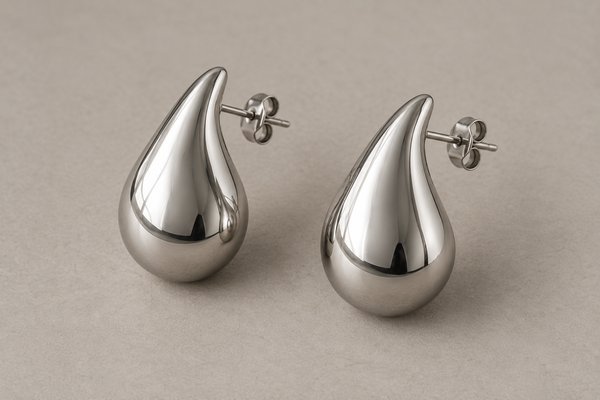
Large earrings create an immediate visual impression, but the wholesale specification should explain more than height and width. Weight distribution, post position and backing design influence how the product sits. A striking front photograph can conceal a heavy or poorly balanced structure. Review the complete pair and its intended wearing experience before making it the centerpiece of a new collection.
Evaluate statement earrings through measured weight per earring and per pair, construction, post placement, backing support and a suitable fit review. Size alone does not establish comfort, and a hollow-looking rendering does not confirm the finished product's weight.
Measure the finished product consistently
Measure left and right finished earrings separately in grams, then the complete pair with the supplied backs. Record scale resolution, height, width and depth in millimetres. Measure every size and colourway using the same method.
Compare Stainless Steel Large Hoop Earrings and Stainless Steel Dangle Earrings as statement-earring directions. Request the actual finished pair weight and review the relevant closure or support system on each selected sample.
Keep the values with the sample ID and construction record. Weight helps buyers compare designs but does not establish comfort for every wearer; fit, anatomy, movement and wearing duration also matter.
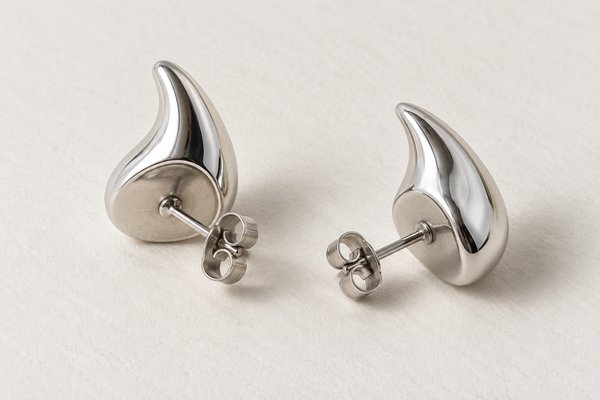
Ask how the shape is constructed
Ask whether the proposed body is solid, hollow or formed, and review its back, underside, edges and joins on the physical sample. Similar front silhouettes can conceal different structures.
| Construction | Potential benefit | What buyers must inspect |
|---|---|---|
| Solid metal body | Can provide a substantial, sculptural appearance | Finished weight, balance, smooth edges and post attachment |
| Hollow construction | May reduce weight while preserving visual volume | Wall thickness, dents, seams, strength and consistency |
| Formed metal sheet | Can produce a larger silhouette with less material | Sharp edges, joining points, deformation and finish quality |
Confirm the forming, joining and polishing route before approval. A lighter body must still withstand normal handling; document construction changes and review a revised sample.
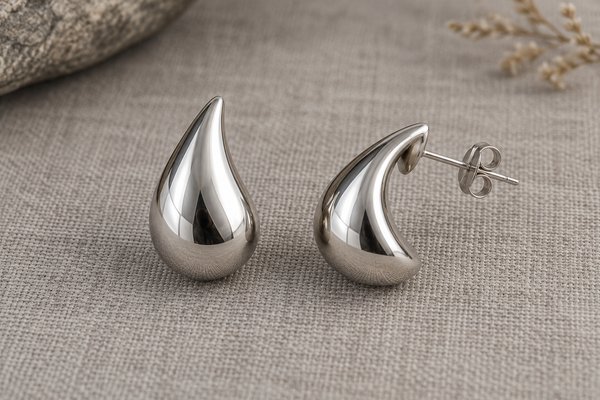
Review post placement and backing as one system
Review the decorative body, post and exact supplied backing together. Check post alignment, engagement, attachment and the way the assembly sits in front and side views.
A larger support backing may spread contact over a wider area, but its fit and security require a complete-pair review. Treat any backing substitution as a change requiring approval.
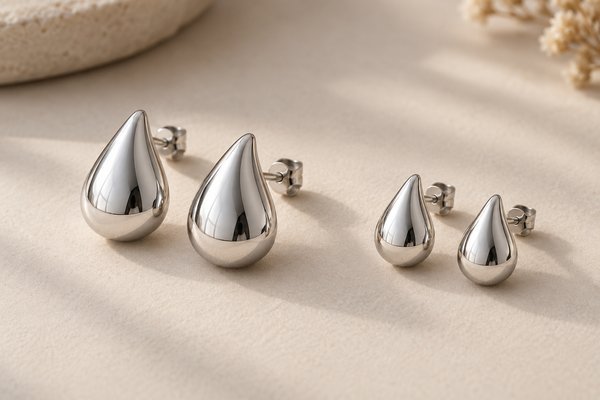
Create useful information for retailers
Provide dimensions, the weight convention, construction and backing model alongside front, side and rear photographs. Use the product photography brief to keep these views consistent.
Record wearing-review conditions and specific observations. Retain the approved pair and revise retailer information if the bulk product or a repeat order changes.
How weight distribution affects statement earring comfort
A decorative body projecting farther from its support can create a greater tendency to tilt than a compact body of similar mass. Total weight and weight distribution should therefore be reviewed together.
Observe forward tilt, left-right symmetry and movement using the intended post and backing. Record the conditions and findings of a physical review; geometry alone cannot establish a universal comfort rating.
Materials, surface finishing and buyer compliance checks
Consult ECHA’s official nickel restriction entry and referenced standards alongside the reports for the finished SKU.
For custom stainless steel earrings, ask the supplier to specify the decorative body and the ear post separately. The visible body, post and backing may differ in construction or material, so do not infer the entire assembly’s specification from a front-view image. Confirm the exact material, finish and any 18K-colour PVD requirement on the physical approval sample.
For EU sales, request relevant supporting documentation for the finished article, including applicable REACH restrictions and nickel-release evaluation for skin-contact components. EN 1811 is a nickel-release test method, not a general certificate that guarantees full EU regulatory compliance. Whether testing or retesting is needed depends on the material, finish, components and intended market; obtain evidence for the specific production configuration rather than relying on an unrelated certificate.
Buyers planning custom shapes can review our custom jewelry options and browse the stainless steel earring category before preparing an RFQ.
How to reduce statement earring weight without compromising quality
Ask whether hollow or formed construction can preserve the silhouette with less material. Confirm adequate strength at seams and post joints, then inspect edges, deformation and surface finish on the finished prototype.
Review post position with the exact backing rather than moving it automatically to the top. A change in construction, hardware or finish requires review of the revised assembly before bulk approval.
Sample approval and bulk QC checklist
| Checkpoint | Information to approve | Bulk-order verification |
|---|---|---|
| Dimensions | Height, width and depth of each version | Measure units against agreed sample/tolerance |
| Finished weight | Per earring and per pair; specify whether backs are included | Use the same scale method and compare with approved values |
| Metal construction | Solid/hollow/formed design and rear-view photographs | Check seams, wall integrity and deformation |
| Post and backing | Location, alignment, size and exact backing model | Check secure attachment and consistency across pairs |
| Surface quality | Approved colour, polish, edge finishing and visible joins | Inspect for scratches, sharp edges and finish differences |
| Retail evidence | Sample reference, multi-angle photos and tested observations | Match descriptions and images to the shipped product |
A sensible purchasing workflow uses a documented approval sample, a mutually agreed tolerance plan and appropriate checks throughout production. See our jewelry product photography brief for consistent front, side and rear images, and our ODM jewelry manufacturing overview when developing a new structure.
One sample comparison and specification record
Use this record for Sample A and Sample B, then retain the chosen physical pair as the production reference. Complete the fields only after measuring the actual finished samples.
| Record | Sample A | Sample B |
|---|---|---|
| SKU, sample date and revision | To record | To record |
| Left / right earring; pair with backs (g) | To measure | To measure |
| Height × width × depth (mm) | To measure | To measure |
| Body construction, material and finish | To confirm | To confirm |
| Post position and backing model | To record | To record |
| Review conditions, tilt and handling observations | To review | To review |
| Agreed tolerances and approval decision | To agree | To agree |
Attach multi-angle photographs and relevant reports to the same record. For hinged designs, also use the earring closure review. These unfilled fields are a purchasing worksheet, not published laboratory results.
Buyer FAQ
Is there one comfortable weight limit?
No single limit establishes comfort for every wearer and design. Compare measured weight with fit, support and a documented review.
Are hollow earrings always more comfortable?
No. Lower mass can help, but balance, post location and backing fit also affect the assembly. Compare finished samples.
Should a replacement backing be approved again?
Yes. Review its engagement, security and support with the earring, and record the approved replacement before production.
What weight information should a supplier provide?
Request grams for the left and right earrings and the complete pair with backs. Confirm the scale method and measurement convention for every SKU.
Which documents should an EU buyer request?
Request reports relevant to the finished configuration. Check the tested components, material, coating, report date and scope; a report for another design may not cover yours.
Plan your wholesale project
Need a manufacturable statement earring design for your wholesale collection? Explore our stainless steel earring range, review our sample approval checklist, and contact Yleryler for a custom jewelry quotation.
For a useful first response, include your reference images or CAD drawing, proposed height and width, estimated quantity per design/finish, metal and coating preferences, target market, requested sample date and delivery destination. We can then discuss construction feasibility, sampling, production specifications and quotation requirements; final minimum quantity, price and lead time depend on the approved design.
Send Your Earring RFQ → | Browse Earring Designs →
Editorial contact: Bill Hou, Yiwu Feiliu Accessories Co., Ltd. — contact for B2B jewelry sourcing and sample coordination.
Evidence note: Images are illustrative concepts. The unfilled worksheet is a review tool; actual weight, comfort observations and test reports must come from the finished SKU and approved sample.